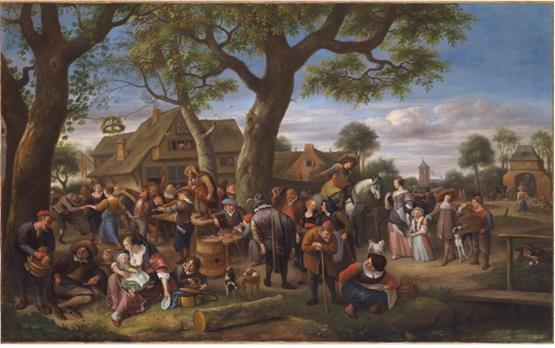
Jan Steen (1626-1679), Peasants Merrymaking Outside an Inn (previously Fair at Warmond), ca. 1676. Oil on canvas. The Leiden Collection, JS-108. Courtesy of The Leiden Collection, New York
New York, NY –This spring, The New York Historical provides visitors with an extraordinary glimpse into life in New Amsterdam through portraits, genre scenes, and still life paintings created by renowned 17th-century Dutch masters, among them, Rembrandt van Rijn. The exhibition, Old Masters, New Amsterdam , is on view May 1 to August 30, 2026.
In this first-of-its-kind exhibition, which celebrates the 400th anniversary of the founding of New Amsterdam, paintings by Rembrandt and his contemporaries help imagine the world of the Dutch settlement that would eventually become New York, depicting people at home, at the marketplace, at prayer, at play, and in taverns.
Featuring objects from The New York Historical’s collection and more than 60 Dutch 17th-century paintings, including works from the Leiden Collection—among the largest and finest collections of 17th-century Dutch art in private hands—the exhibition also includes works from a variety of institutions, including the Museum of Fine Arts Boston, National Gallery of Art, Virginia Museum of Fine Arts, the New York State Archives, and Trinity Church, as well as private collectors.
“As we continue our commemoration of the United States’ 250th anniversary, we are thrilled to have the opportunity to showcase works of art by Rembrandt van Rijn, Frans Hals, and Jan Steen, many of which have never before shown in New York,” said Dr. Louise Mirrer, president and CEO of The New York Historical. “Old Masters, New Amsterdam is a fascinating view into daily life in New Amsterdam—a diverse settlement and a place of commerce, creativity, and conflict, which laid the foundations of the city and nation we know today.”
“Four centuries ago, the Dutch founded an outpost at the tip of Manhattan Island—a humble but vibrant settlement that would give rise to New York,” said Russell Shorto, the exhibition’s co-curator, director of the New Amsterdam Project at The New York Historical. “Across the ocean, meanwhile, Rembrandt and his peers were transforming art, revealing the beauty and drama of everyday life. These Dutch artists never set foot in New Amsterdam, but their portraits, character studies, and depictions of daily life in the Netherlands provide real insight into the world of Manhattan’s 17th-century settlers.”
“The Dutch greatly enjoyed family festivities that included music, dancing, food, and drink,” said Arthur Wheelock, co-curator of the exhibition, and senior advisor to the Leiden Collection. “Jan Steen’s joyous Peasants MerrymakingOutside an Inn, for example, wonderfully captures the vibrancy and wide range of human interactions that could be found at a country fair, whether in the Netherlands or in New Amsterdam.”
In the 1600s, the tiny Dutch Republic became a global power, outpacing larger nations through bold innovations in trade and finance. By entrusting overseas ventures to private companies, the Dutch extended their reach across the oceans, bringing home spices, textiles, and extraordinary wealth.
From 1626 to 1664, New Amsterdam was the capital of New Netherland, a colony established by the Dutch West India Company that stretched across parts of five future states. The Dutch policy of religious toleration spawned an unusually pluralistic society, in which at least 18 languages were spoken. The city’s position and its diverse inhabitants made it a hub of global trade in the Atlantic network.
Some of the finest Dutch artists of the 17th century, among them Rembrandt van Rijn, Jan Lievens, Gabriel Metsu, Frans Hals, and Jan Steen, painted portraits and character studies. Though portraying scenes in the Netherlands, these works of art offer hints of what life was like in New Amsterdam for government officials, fur traders, preachers, doctors, and women at home and in the markets. One of the most memorable portraits on view is Rembrandt’s engaging Self-Portrait from 1634, which the young master painted just as he was becoming Amsterdam’s most celebrated artist. Rembrandt’s large portrayal of a dignified Amsterdam merchant, painted much later in his career, projects the gravity of a wealthy gentleman who has assumed social and political responsibilities in his life.
Homes in New Amsterdam echoed those of the old country, though they were generally more modest. Paintings of Dutch interiors on view offer glimpses into the rhythms of domestic life on Manhattan Island. As evident in Gerrit Dou’s Herring Seller and Boy, shopkeeping was a common way for a woman to make a living at home during the era. Paintings of Dutch women reading also echo the habits in New Amsterdam, where people devoured books and pamphlets. Each arriving ship brought letters with news from the home country. Gabriel Metsu’s Smoker Seated at a Table, and Caspar Netscher’s Two Women in an Interior with a Basket of Lemons, also provide tangible examples of how integral the transatlantic trade had become during this period, and how it brought luxury products within reach of ordinary citizens.
The exhibition includes market scenes as well as still-life paintings by Pieter Claesz and Frans Snyders that depict the types of foods that could be savored in New Amsterdam. Tavern life, where the Dutch enjoyed gathering for drink and song, is also seen in several works. Music was a constant feature in Dutch life, whether in the quietude of one’s home, on street corners, or at county fairs, as in Jan Steen’s large Peasants Merrymaking outside an Inn.
The story of New Amsterdam is also one of exploitation. Indigenous people were displaced, and the first enslaved Africans arrived only a year after the city’s founding. On display from The New York Historical’s collections are maps, portraits, and a deed from 1651 granting property north of New Amsterdam to Manuel de Spangie, a formerly enslaved African who had won his freedom a few years earlier. Works by the Bohemian artist Wenceslaus Hollar showcase rare likenesses of people whose societies were reshaped by colonialism, including Native Americans. The figures shown in Head of a Young Black Boy (1635) and Head of a Black Woman with a Lace Kerchief Hat (1645) may have been household servants in Amsterdam or Antwerp. While slavery was technically illegal in Amsterdam, the line between “servant” and “slave” was a blurry one.
Also on view are two foundational documents in the early struggle for religious freedom in America: the Flushing Remonstrance and the journal of Quaker leader John Bowne.
The exhibition ends with several paintings providing a glimpse into 1776 and beyond. The individuality fostered in the Dutch era evolved into a New York hallmark: a brash, confident, entrepreneurial energy. On the eve of the American Revolution, the city’s diversity made it a cauldron of debate and unrest. Built on Dutch foundations and shaped by waves of newcomers, New York reflected the American experiment and propelled it forward. From The New York Historical’s collection, Francis Guy’s 1797 painting Tontine Coffee House, New York City, where commercial activity seemingly bursts across the canvas, shows the expansive growth of the city in the century after the Dutch founded New Amsterdam.
Accompanying the exhibition is a digital 3D reimagining of the 1660 Castello Plan. Created in partnership with the New Amsterdam History Center, this interactive map lets visitors step directly into 17th-century New Amsterdam—exploring the interior of a home and visiting the original City Hall, the Indian Trading House, and a house where enslaved Africans lived. The map also traces the Lenape trail that would later become Broadway, revealing the living city beneath today’s street.
The exhibition is co-curated by Russell Shorto, director of the New Amsterdam Project at The New York Historical, and Arthur K. Wheelock Jr., senior advisor to the Leiden Collection.
Programming On May 4, the exhibition’s co-curator Russell Shorto and the Leiden Collection’s Elizabeth Nogrady lead a special tour of Old Masters, New Amsterdam, offering an Old Master’s view of New Amsterdam. On May 20, author Alan Mikhail joins Russell Shorto to explore the exceptional story of one of New York’s most unorthodox founding families, a poor immigrant couple named Anthony and Grietje, who arrived in Dutch New Amsterdam in the 1630s in search of a better life and ended up changing the course of New York’s history.
For families, there will be story time themed to the exhibition. Visit the family calendar for details. Private group tours can also be arranged throughout the exhibition.
New York’s first museum, The New York Historical is a leading cultural institution covering over 400 years of American history. A museum of museums and a collection of collections, The New York Historical is home to the Patricia D. Klingenstein Library, the Center for Women’s History, the DiMenna Children’s History Museum, and the future American LGBTQ+ Museum.
New York, NY—The New York Historical’s new exhibit, The Gay Harlem Renaissance, examines the Black LGBTQ+ artists, writers, and performers central to the Harlem Renaissance and everyday Black gay life in the early 20th century. Marking the centennial of The New Negro—the landmark 1925 anthology edited by Alain Locke—the exhibition traces the queer creativity, friendship circles, and mentorships that flourished in Harlem’s salons, social clubs, and thriving nightlife and that helped power the Harlem Renaissance.
This may well be the first exhibition to explore the Harlem Renaissance through a LGBTQ+ lens. “The Gay Harlem Renaissance” is on view through March 8, 2026.
As Harlem grew into the nation’s largest Black metropolis after the First World War, Black Southern and Caribbean migrants, activists, and creatives transformed the neighborhood into a nexus of political activism, creative expression, and community life. Many of Harlem’s most celebrated poets, novelists, and artists were gay or bisexual (some discreetly and others openly); and many of the preeminent blues singers performing in nightclubs and basement speakeasies were lesbian, bisexual, or transmasculine.
Gladys Bentley is featured in New York Historical’s “Gay Harlem Renaissance” (unidentified photographer, 1946-1949. Gelatin silver print. Collection of the Smithsonian National Museum of African American History and Culture)
Whether on Harlem’s biggest stages or in its nightclubs or hidden speakeasies, LGBTQ+ performers took center stage. Together they helped shape the cultural innovation that defined the era. Amid this cultural convergence, queer and straight artists formed close-knit circles—living together, mentoring one another, and exchanging ideas that shaped the future of Black art and culture. Their creative tensions—whether over how openly to depict same-sex desire or the so-called “unrespectable” venues of Harlem’s nightlife—helped shape the bold, expansive spirit of the Harlem Renaissance.
“The Gay Harlem Renaissance provides a sweeping portrait of Harlem after the First World War, when a remarkable generation of Black artists, thinkers, and performers—many of them members of the LGBTQ+ community—shaped a new cultural vanguard,” said Dr. Louise Mirrer, president and CEO of The New York Historical. “We hope that this show will invite visitors to consider how intimate friendships, chosen families, and radical ideas about identity helped define the Harlem Renaissance and continue to resonate today.”
“The Gay Harlem Renaissance shows that Black LGBTQ+ life was far more visible, accepted, and integrated into the daily life of 1920s Harlem than most people imagine,” said George Chauncey, the exhibition’s chief historian, a Columbia history professor who is the author of Gay New York, 1890-1940. “The exhibition takes visitors to the basement speakeasies, rent parties, and drag balls where ordinary queer and straight people built lives together, as well as to the salons of the cultural elite.”
Featuring more than 200 objects, The Gay Harlem Renaissance unites painting, sculpture, artifacts, documents, photographs, books, and music from collections across the country and celebrates the creativity, innovation, and resilience of Black LGBTQ+ Harlemites.
Highlights of the exhibition include:
Employment of the Negro in Agriculture, a 1934 painting by Earle Richardson, on loan from Howard University, honors the resilience of African American agricultural laborers within the oppression of the Jim Crow system.
Color, the 1925 first edition of Countee Cullen’s first book of poetry, published when he was 22. Countee Cullen found a champion and mentor in Alain Locke, who included his poetry in The New Negro and helped Cullen accept his sexuality.
Gelatin silver print of Gladys Bentley, circa 1927-45. Taunted as a child for her unfeminine demeanor, the transmasculine performer Gladys Bentley became a star in Harlem, singing and playing piano all night at rent parties and popular nightclubs. Her signature white tuxedo and top hat have become icons of queer self-expression on and off the stage.
Rent party tickets. Throwing apartment parties with a small cover charge in exchange for entertainment and lively company helped working-class residents pay the rent. The fact that LGBTQ+ Harlemites could dance and flirt with people of the same sex at such parties was a powerful sign of their acceptance among Harlem’s working-class residents.
Meditation and Music, a 1925 watercolor by Aaron Douglas. Influenced by the work of Alain Locke, Douglas moved to Harlem, where he illustrated some of the most famous books and magazines of the Harlem Renaissance. While Douglas was not gay, he was close to many Black queer artists and moved in their social circles.
Sculptures by Richmond Barthé, whose artworks chart his movement through interracial and transatlantic gay social circles. His subjects included the popular singer and nightclub owner Jimmie Daniels and the queer Senegalese dancer François “Féral” Benga, whom he met in Paris.
1939 issue of The Crisis magazine. Black publications experienced tremendous growth in readership, circulation, and influence during the interwar years. The Black press provided coverage of the vibrant political, cultural, and social life in Harlem and beyond.
Photographs by Morgan Smith and Marvin Smith created an extraordinary documentary record of the Harlem community from the 1930s to 1950s. Their work captured Black joy and struggle alike. They came to know most of the pioneering figures of the Harlem Renaissance as well as rising talent.
Recordings of blues songs with queer themes by singers such as Bessie Smith, Ma Rainey, and Ethel Waters, as well as specially created audio recordings of poetry by Langston Hughes and other poets, as well as a passage from Nella Larsen’s novel, Passing.
Recreation of the prize-winning gown worn by Bonnie Clark at the 1932 Hamilton Lodge Ball, the largest drag ball on the East Coast, which was held every February in Harlem’s Rockland Palace.
Harlem Diner, a 1938 painting by Jacob Lawrence, depicting five Black figures with downturned expressions gathered in a Harlem diner, facing the struggles of daily life. During the Great Depression, Harlemites faced mass unemployment, overcrowding, and persistent racial discrimination.
The exhibition is curated by lead curator Allison Robinson, associate curator of history exhibitions; with Anne Lessy, assistant curator of history exhibitions and academic engagement; with Rebecca Klassen, curator of material culture and decorative arts, contributing; and with George Chauncey, author of Gay New York and DeWitt Clinton Professor of American History at Columbia University, as chief historian.
Programming: A family guide for young visitors to the exhibition will be available. Living History programs focused on Gladys Bentley will also take place at a future date. Visit the family calendar for details. Private group tours can also be arranged throughout the exhibition.
Lead support for The Gay Harlem Renaissance is provided by the Mellon Foundation. Important support is provided by Pamela and David Hornik. Exhibitions at The New York Historical are made possible by Dr. Agnes Hsu-Tang and Oscar Tang, the Saunders Trust for American History, the Evelyn & Seymour Neuman Fund, the New York City Department of Cultural Affairs in partnership with the City Council, and the New York State Council on the Arts with the support of the Office of the Governor and the New York State Legislature. WNET is the media sponsor.
New York’s first museum, The New York Historical is a leading cultural institution covering over 400 years of American history. Offerings span groundbreaking exhibitions; peerless collections of art, documents, and artifacts; acclaimed educational programs for teachers and students nationwide; and thought-provoking conversations among leading scholars, journalists, and thinkers about the past, present, and future of the American experiment. The New York Historical is a museum of museums and a collection of collections and home to the Patricia D. Klingenstein Library, the Center for Women’s History, the DiMenna Children’s History Museum, and the future American LGBTQ+ Museum. “We elevate the perspectives and scholarship that define the United States’ democratic heritage and challenge us all to shape our ongoing history for the better.”
The New York Historical, 170 Central Park West (77th Street), New York, NY 10024, 212-873-3400, nyhistory.org.
New York —Encouraged by unprecedented demand, the Anne Frank House announced the second and final extension of its world premiere presentation of Anne Frank The Exhibition in New York City at the Center for Jewish History. The exhibition will remain open through February 1, 2026, before moving to the next U.S. city.
During this final extension of Anne Frank The Exhibition in New York, organizers are providing complimentary admission on several select dates, opening the doors to even more visitors to remember and reflect on Anne’s legacy. Special access days provide complimentary admission for two adults and up to four children, as noted below.
“It has become powerfully evident since the opening of this exhibition that people from every walk of life feel a deep, urgent need to connect with Anne’s story and confront the realities of the Holocaust firsthand. The reflections and courageous conversations sparked by every visitor have shown how this exhibition has a role in challenging hate,” said Ronald Leopold, Executive Director of the Anne Frank House. “Our responsibility to honor Anne’s legacy grows stronger each day. Extending the exhibition is a necessary response to the troubling state of antisemitism and hatred around the world. And soon, we will introduce an innovative resource designed to help educators and students build a deeper, more informed understanding of antisemitism—at a moment when consensus is most at risk. We are unwavering in our resolve to fight all forms of hate, fueling understanding and resilience through education.”
Since its opening, Anne Frank The Exhibition has drawn hundreds of thousands of visitors, including students, teachers, and librarians from almost every state across the nation and more than a dozen countries, providing an immersive experience in the heart of Manhattan and offering deep historical context through never-before-seen artifacts, multimedia, and Anne’s powerful personal narrative.
Anne Frank The Exhibition is the first time ever that the Anne Frank House presents a pioneering experience outside of Amsterdam to immerse visitors in a full-scale recreation of the Annex rooms, fully furnished, where Anne Frank, her parents and sister, and four other Jews spent two years hiding to evade Nazi capture.
Moving through the exhibition, visitors can immerse themselves in the context that shaped Anne’s life—from her early years in Frankfurt through the rise of the Nazi regime and the family’s phased move to Amsterdam across 1933 and 1934, where Anne lived for ten years until her 1944 arrest and deportation to Westerbork, a large transit camp in the Netherlands, then to Auschwitz-Birkenau, a concentration camp and killing center in Nazi-occupied Poland, and eventually to her death at Bergen-Belsen concentration camp in Germany when she was 15 years old.
Four exhibition galleries immerse visitors in place and history through video, sound, photography, animation, and more than 100 original collection items from the Anne Frank House in Amsterdam. Anne Frank The Exhibition provides an opportunity to learn about Anne Frank not as a victim but through the multifaceted lens of her life—as a girl, a writer, and a symbol of resilience and strength. This is a story inspired by one of the most translated books in the world.
The New York City exhibition occupies over 7,500 square feet of gallery space in the heart of Union Square. This marks the first time dozens of artifacts can be seen in the United States—many have never been seen in public.
Artifacts in the exhibition include:
Anne Frank’s first photo album (1929-1942);
Anne Frank’s typed and handwritten invitation to her friend for a film screening in her home (by 1942, anti-Jewish measures prohibited Jews from attending the cinema); and
Handwritten verses by Anne Frank in her friends’ poetry albums.
Special Access Days with complimentary admission:
General admission tickets are available every day the exhibition is open, and complimentary admission will be offered to select visitors on the following dates:
Thursday, September 11th: All day access for Hometown Heroes (police officers, firefighters, first responders, medical professionals, and military personnel)
Thursday October 9th and Friday, October 10th: All day access for librarians, in recognition of Banned Books Week
Thursday, October 9th: Access for Queens Public Library Card Holders from 3:30 p.m. to 6:30 p.m.
Monday, October 13th (Columbus Day/Indigenous People’s Day): All day access for families, Hometown Heroes, and educators (exhibition closes at 2:00 p.m.)
November 4 (Election Day): All day access for families, Hometown Heroes, and educators
November 11 (Veterans Day): All day access for families, Hometown Heroes, and educators
Official ID and email are required for police officers, firefighters, first responders, medical professionals, military personnel, educators, and librarians for free admission on special access days. Tickets for special access days are available with day-of on-site registration.
Merryl Tisch, Chairman of the Board of Trustees of the State University of New York, and former Chancellor of the New York State Board of Regents, said, “Anne Frank’s story is a timeless beacon for education that goes beyond history, teaching us the essential values of resilience, empathy, and standing against antisemitism and hatred. It is our responsibility as leaders and educators to ensure that students of all ages learn these lessons deeply, so that Anne’s legacy inspires a more inclusive and compassionate future.”
New York State Education Commissioner Betty A. Rosa said, “Anne Frank The Exhibition provides a profound educational experience that connects the lessons of history to the challenges and responsibilities of today. It provides students with a meaningful opportunity to explore the realities of antisemitism and intolerance while equipping educators with resources to thoughtfully integrate these lessons into their instruction. This exhibition not only honors the memory of Anne Frank and her family but also strengthens our shared responsibility to ensure that future generations learn the importance of empathy, tolerance, and standing against hate in all its forms.”
“It has been deeply meaningful to host this exhibition and share its vital history with the public. With this final extension, we look forward to welcoming even more visitors to engage with Anne Frank’s story and the lessons it continues to impart,” said Dr. Gavriel Rosenfeld, President of the Center for Jewish History.
With this final extension through February 1, 2026, the Anne Frank House reaffirms its mission to ensure Anne’s voice continues to inspire unity and peace across generations.
General Information
Tickets are available at AnneFrankExhibit.org. The exhibition is designed for children (ages 10 and older) and adults. All general admission tickets include the exhibition audio guide. Visitors should plan to spend approximately one hour at the exhibition. The last entry is one hour before closing.
Individual tickets
Timed entry tickets, Monday through Friday: $24 (17 and under, $18)
Timed entry tickets, Sunday: $31 (17 and under, $24)
Flex tickets, Monday through Friday: $38
Flex tickets, Sunday: $54
Family tickets (2 adults + 2 children under 17 years):
Timed entry tickets, Monday through Friday: $74 (additional 17 and under ticket, $18)
Timed entry tickets, Sunday: $98 (additional 17 and under ticket, $24)
Group sales (adults)
$300 per group of 10, timed entry, Monday through Friday
$400 per group of 10, timed entry, Sunday
Hours: Sunday through Thursday: 9:30 a.m. to 7:30 p.m.; Friday: 9:30 a.m. to 3:30 p.m. Saturday: Closed.
Center for Jewish History 15 West 16th Street, New York, 212.294.8301,cjh.org, info@cjh.org.
“Summer of Reflection: The Legacy of Anne Frank” citywide initiative expands with “Summer of Service” to thank those who educate, protect, and inspire New Yorkers
New York, N.Y. — This summer,Anne Frank The Exhibition is expanding its efforts to introduce as many New Yorkers as possible to Anne Frank’s legacy of hope and courage, offering enhanced access and free admission to thousands of public service champions, including teachers, first responders, active military, and librarians. The immersive and historically significant exhibition, presented by the Anne Frank House in Union Square at the Center for Jewish History, will launch the new initiative beginning Friday, July 11th through Friday, August 29th.
“We are honored to welcome public servants through enhanced access to the exhibition, inviting them to draw strength from Anne Frank’s enduring legacy of humanity and courage,” said Ronald Leopold, Executive Director of the Anne Frank House in Amsterdam, which organized the New York City exhibition. “Summer of Service not only recognizes the profound impact public servants have in safeguarding our freedoms, but also affirms their power to shape a more just world. By experiencing Anne Frank The Exhibition firsthand, they harness their collective empathy and resolve, becoming even stronger champions of human dignity and leading the way in the fight against hatred and intolerance.”
The new summer initiatives include:
Teacher Tuesdays:
From 9:30-11:30am, teachers will be granted free access for up to 2 adults and 4 children.
Valid school ID and email address is required for free entry.
First Responder and Active-Duty Wednesdays:
From 12:30-3:30pm, all first responders (including NYPD, FDNY, EMS, and PAPD) as well as active-duty service members, will be granted free access for up to 2 adults and up to 4 children.
Valid government-issued ID is required for free entry.
Public Librarian Weekday Evenings:
On Monday through Thursday, from 5:00-6:30pm, all NYC public librarians will be granted free access for up to 2 adults and up to 2 children.
Valid ID and NYC public library email address is required.
From 2:45-5:00pm, the exhibit is offering free entry to all visitors (last entry at 4:00pm).
The first 100 NYC library cardholders to arrive will receive expedited access on these Free Fridays. Free Friday afternoon access is offered on a first-come, first-served basis, and is limited to 250 visitors each Friday. Last entry is 4:00 pm, one hour before closing (5:00pm on Fridays). Teacher Tuesdays, First Responder and Active-Duty Wednesdays, and Public Librarian Weekday Evenings begin on July 11th and will last through August 29, 2025. Originally planned to close earlier this year, Anne Frank The Exhibition is now extended through October 31, 2025 to offer even more New Yorkers the opportunity to learn about Anne’s life and writings.
A tribute to public servants, Summer of Service extends Summer of Reflection: The Legacy of Anne Frank with a powerful message of gratitude to those who educate and protect New Yorkers. Summer of Service expandsexhibition access for New York City’s everyday heroes, such as teachers, first responders, and librarians.
Summer of Reflection: The Legacy of Anne Frank includes the distribution of 10,000 copies of Anne Frank: The Diary of a Young Girl across New York City and is made possible thanks to the generosity of Bank of America and UJA-Federation of New York, in collaboration with the New York City Public Schools Office of Library Services, New York City Public Schools Department of Social Studies & Civics, New York City Public Schools Summer Rising enrichment program, and the New York Public Library, Queens Public Library, and Brooklyn Public Library.
About Anne Frank The Exhibition:
Anne Frank The Exhibition is the first time in history that the Anne Frank House presents a pioneering experience outside of Amsterdam to immerse visitors in a full-scale recreation of the Annex rooms, fully furnished, where Anne Frank, her parents and sister, and four other Jews spent two years hiding to evade Nazi capture.
Moving through the exhibition, visitors can immerse themselves in the context that shaped Anne’s life—from her early years in Frankfurt through the rise of the Nazi regime and the family’s phased move to Amsterdam across 1933 and 1934, where Anne lived for ten years until her 1944 arrest and deportation to Westerbork, a large transit camp in the Netherlands, then to Auschwitz-Birkenau, a concentration camp and killing center in Nazi-occupied Poland, and eventually to her death at Bergen-Belsen concentration camp in Germany when she was 15 years old.
Four exhibition galleries immerse visitors in place and history through video, sound, photography, and animation; and more than 100 original collection items from the Anne Frank House in Amsterdam. Anne Frank The Exhibition provides an opportunity to learn about Anne Frank not as a victim but through the multifaceted lens of her life—as a girl, a writer, and a symbol of resilience and strength. This is a story inspired by one of the most translated books in the world.
The New York City exhibition occupies over 7,500 square feet of gallery space in the heart of Union Square. This marks the first time dozens of artifacts can be seen in the United States—many have never been seen in public.
Artifacts in the exhibition include:
Anne Frank’s first photo album (1929-1942);
Anne Frank’s typed and handwritten invitation to her friend for a film screening in her home (by 1942, anti-Jewish measures prohibited Jews from attending the cinema); and
Handwritten verses by Anne Frank in her friends’ poetry albums.
Advising the Anne Frank House on the New York City exhibition is Michael S. Glickman, CEO of jMUSE. Dr. Doyle Stevick, Executive Director of The Anne Frank Center at the University of South Carolina, the Anne Frank House’s official U.S. partner, is the educational advisor.
Anne Frank The Exhibition is a limited engagement, now extended through October 31, 2025.
The exhibition is made possible by Leon Levy Foundation, with leadership support by David Berg Foundation, Rebecca and Jared Cohen, Stacey and Eric Mindich, The Koum Family Foundation, Merryl and James Tisch, UJA-Federation of New York, and corporate partner Bank of America. Educational patrons to the exhibition include Gray Foundation and The Fuhrman Family Foundation, with additional support by The Barbra Streisand Foundation.
Major support has been provided by Debbie and Mark Attanasio, Tanya and Ryan Baker, Einstein Astrof Foundation, Elyssa and William Friedland, Jesselson Foundation, Allison and Warren Kanders, Pershing Square Philanthropies, Sara Naison-Tarajano, The Krupp Foundation, Katharine M. and Leo S. Ullman, and Anonymous, with sponsorship support by GRoW @ Annenberg, Rita J. & Stanley H. Kaplan Family Foundation, Karyn Kornfeld & Steven Kobre, The Claire Friedlander Family Foundation, and Zegar Family Foundation. Pro bono legal services provided by Wachtell, Lipton, Rosen & Katz.
General Information
Following months of being sold out, additional tickets have been added for the months of June, July, and August to ensure visitors have easy access to the exhibition. Tickets available at AnneFrankExhibit.org. The exhibition is designed for children (ages 10 and older) and adults. All general admission tickets include the exhibition audio guide. Visitors should plan to spend approximately one hour at the exhibition. Last entry is one hour before closing.
Individual tickets
Timed entry tickets, Monday through Friday: $24 (17 and under, $18)
Timed entry tickets, Sunday: $31 (17 and under, $24)
Flex tickets, Monday through Friday: $38
Flex tickets, Sunday: $54
Family tickets (2 adults + 2 children under 17 years):
Timed entry tickets, Monday through Friday: $74 (additional 17 and under ticket, $18)
Timed entry tickets, Sunday: $98 (additional 17 and under ticket, $24)
Group sales (adults)
$300 per group of 10, timed entry, Monday through Friday
$400 per group of 10, timed entry, Sunday
Hours: Sunday through Thursday: 9:30 a.m. to 7:30 p.m.; Friday: 9:30 a.m. to 3:30 p.m.; Saturday: Closed
Center for Jewish History, 15 West 16th Street, New York, N.Y. between 5th and 6th Avenues
In July 1942, Anne Frank (13), her parents, Otto and Edith Frank, and her sister, Margot Frank (16), went into hiding in the annex at the back of her father’s company. The Van Pels family (Hermann, Auguste, and their 15-year-old son, Peter) followed the next week. Four months later, they were joined by Fritz Pfeffer. All of them were Jews daring to escape certain death at the hands of the Nazis amid the German occupation of the Netherlands during World War II. Unable to go to school, largely cut off from the rest of the world, and trapped in close quarters with others while a war raged outside, Anne poured herself into her diary. The people in hiding in the Annex were discovered in 1944, and Anne and the others were arrested and sent to the Auschwitz-Birkenau concentration and extermination camp. Anne and her sister Margot were then sent to the Bergen-Belsen concentration camp, where they both died of typhus in February 1945. Anne was 15. Margot was 18 or 19. Otto Frank was the only person from the Annex to survive the Holocaust.
Anne Frank: The Diary of a Young Girl, more commonly known as The Diary of Anne Frank, is one of the most translated books in the world. Transformed multiple times for stage and screen, the published book’s source is the personal diary that Anne Frank kept in multiple notebooks during the two-year period of hiding with her family in rooms located in the back house of her father’s company in Amsterdam. Soon after Anne and the others were arrested in 1944, Miep Gies, one of the people who risked their lives to help them in hiding, returned to the Annex and found their belongings ransacked. Miep was relieved to find Anne’s diary pages, knowing how important her writings were to her, and saved them for her return. Otto was the only person from the Annex to survive the Holocaust. When Miep first gave him his daughter’s diary, he could not bring himself to read it. Soon, he did and he could not stop, sharing it with relatives and friends who encouraged him to publish what they considered “an important human document.” Upon its publication, Otto Frank wrote: “How proud Anne would have been if she had lived to see this. After all, on 29 March 1944, she wrote: ‘Imagine how interesting it would be if I published a novel about Secret Annex.'”
The Anne Frank House was established in 1957 in cooperation with Otto Frank, Anne Frank’s father, as an independent nonprofit organization entrusted with the preservation of the Annex where Anne Frank and her family went into hiding in 1942 during the Second World War. The Annex is where Anne wrote her diary, and where she and her family hid from the Nazis during the occupation of the Netherlands until being discovered and arrested by police officers in 1944. Following her transport to the Auschwitz-Birkenau concentration and extermination camp, Anne and her sister Margot were sent to the Bergen-Belsen concentration camp, where they died in 1945. For nearly seven decades, the Anne Frank House has served as a place of memory and a place of learning. Committed to bringing Anne’s life story to world audiences, the Anne Frank House has emerged as a primary resource for teaching and learning about the Holocaust. Through Anne’s legacy the Anne Frank House empowers people of all ages—and especially young people—to reflect on the dangers of antisemitism, racism, and discrimination and the importance of freedom, equal rights, and democracy.
The Center for Jewish History illuminates the Jewish past for audiences today and preserves it for the future. Home to the world’s largest Jewish archive outside Israel, it is a dynamic space for learning and public engagement. Opened in 2000, the Center is the collaborative home of five partner organizations (the American Jewish Historical Society, American Sephardi Federation, Leo Baeck Institute, Yeshiva University Museum, and YIVO Institute for Jewish Research) whose collections comprise over 7 miles of archival documents, 500,000 volumes of books, 12 million digital items, and thousands of artworks, objects, textiles, and recordings. The Center opens these vast archives to the public and activates the stories that they hold through exhibits, fellowships, genealogy programs, and an active calendar of events – making it a hub for Jewish culture and heritage. To learn more about the Center and its public programs, visit: cjh.org.
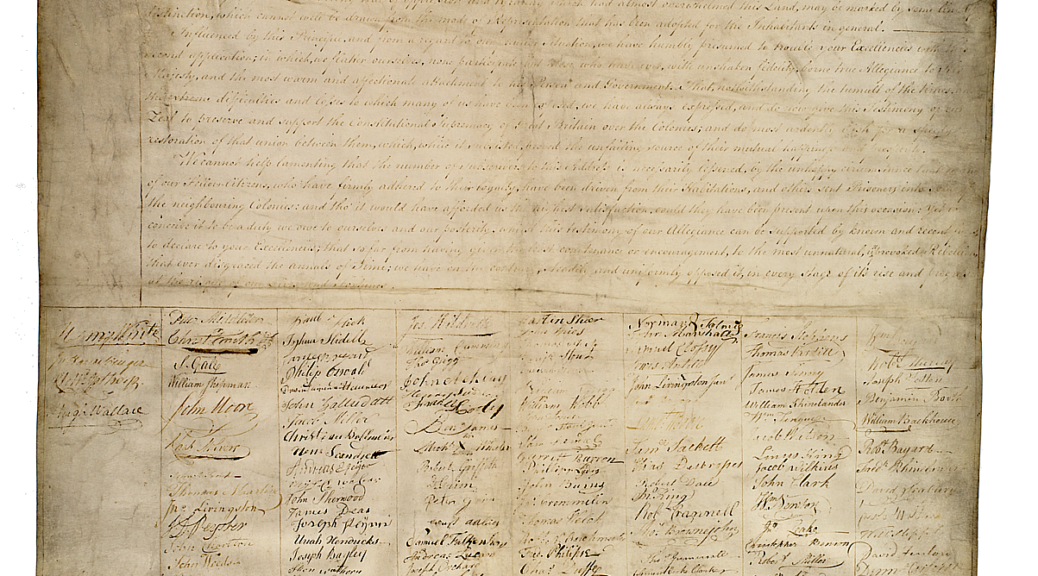
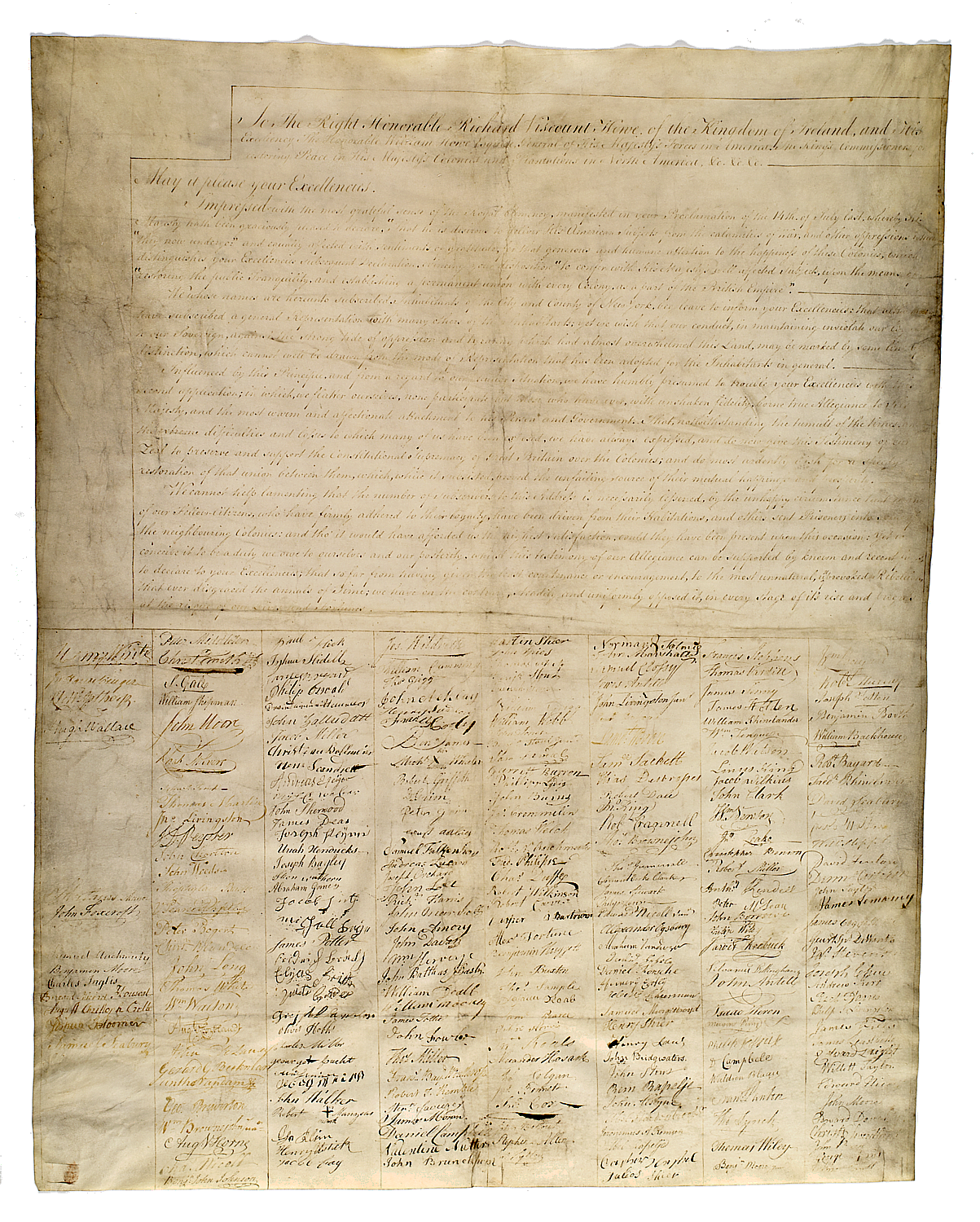
For the first time in more than 20 years, the New-York Historical Society displays the “Declaration of Dependence,” a petition signed in 1776 by New Yorkers loyal to the British crown. The petition will be on view for a limited time, alongside a rare original printing of the Declaration of Independence, also from New-York Historical’s collection.
In an installation entitled Our History of Discord, together these documents reveal the contentious history behind our nation’s founding.
Also, on the Fourth of July, kids under 17 can visit the Museum for free and meet historical interpreters recreating life in New York City in 1776.
“Division in our political views is not a recent phenomenon, and as our nation’s 250th anniversary in 2026 fast approaches, it’s helpful to examine the great divisions we have overcome,” said Louise Mirrer, president and CEO, New-York Historical. “These rare documents on view—offering viewpoints of those loyal to the King and those eager to be rid of him—can help us better understand the role everyday Americans play in the struggle for democracy, including those who have been excluded from it.”
Our History of Discord
Limited Time Only! July 2 – 7, 2024
Just in time for the Fourth of July, get a fascinating look at two essential documents that demonstrate just how tumultuous the birth of the United States really was: a rare New York printing of the Declaration of Independence and a one-of-a-kind “declaration of dependence,” a petition from hundreds of Loyalist New Yorkers pledging their allegiance “to our Sovereign, against the strong tide of oppression and tyranny” at the end of November 1776.
The documents are displayed alongside the Johannes Adam Simon Oertel painting that depicts the night a statue of King George III at Bowling Green was pulled down by a rowdy crowd of revolutionaries on July 9, 1776, after the Declaration of Independence was first read aloud to the troops. Also on view: a surviving piece of that very statue, which has been in the New-York Historical collection since the late 1800s. Curated by Nina Nazionale, director of library curatorial affairs and research at the Patricia D. Klingenstein Library
Independence Day Celebration
Thursday, July 4, 11 am – 5 pm | Free with Museum admission; free admission for ages 17 and younger
Celebrate Independence Day at New-York Historical with humble street food and posh ice cream flavors that would have been familiar to New Yorkers of 1776! Meet historical interpreters to learn the fascinating stories of vendors who sold their wares in the streets and chef Hercules Posey, an enslaved cook of George Washington who self-emancipated in 1796. After sampling foods of the Revolutionary Era, make family memories together with games, crafts, a dress-up photo booth, and more.
New-York Historical Society, 170 Central Park West (77th Street), New York, NY 10024, 212-873-3400, nyhistory.org.
(New York, NY)— This fall, the Museum of Jewish Heritage – A Living Memorial to the Holocaust will present an enriching line-up of in-person and virtual events, including virtual walking tours of historic Jewish sites, launches for four upcoming books about the Holocaust, and a twentieth anniversary 9/11 tribute concert with the Knickerbocker Chamber Orchestra.
“This fall, we’re excited to present an array of programming that will allow our visitors to explore, learn, be entertained, and remember together,” says Museum President & CEO Jack Kliger. “Whether you join us virtually or in-person in our newly renovated Edmond J. Safra Hall, we look forward to offering programs that take you to another place and time and leave you with a new or deeper understanding of Jewish heritage and the Holocaust.”
All in-person events will also be livestreamed and available virtually for audiences around the world.
Fall Highlights include:
Virtual walking tours that highlight the Jewish history and neighborhoods of major European cities such as Budapest, Berlin, and Amsterdam (September 1 – October 17)
Book launches for four new nonfiction books that explore Holocaust history: “All the Frequent Troubles of Our Days,” “ We Share the Same Sky: A Memoir of Memory & Migration,” “Into the Forest: A Holocaust Story of Survival, Triumph, and Love,” and “What They Didn’t Burn: Uncovering My Father’s Holocaust Secrets” (August 31 – October 5)
A special 9/11 tribute concert with the Knickerbocker Chamber Orchestraon the 20th anniversary of the World Trade Center attacks (September 11)
For more information and a full calendar of events, visit the Museum’s events page:
https://mjhnyc.org/current-events/
During in-person events, the Museum’s LOX at Café Bergson will be open for brunch, lunch, and
dinner, serving its Museum-made smoked salmon and other kosher delicacies.
Mildred Harnack was an American activist who witnessed the rise of the Nazi Party in Germany and joined what would become the largest underground resistance group in Berlin as the only American in the leadership of the German resistance. She recruited working-class Germans into the resistance, helped Jews escape, plotted acts of sabotage, and collaborated in writing leaflets that denounced Hitler and called for revolution. When the first shots of the Second World War were fired, she became a spy, couriering top-secret intelligence to the Allies. Harnack would eventually get captured and was sentenced to execution by Hitler and was beheaded.
Join the Museum and Our Travel Circle to discover the vibrant history and culture of Jewish Budapest. On this live, virtual walking tour, tour guide Adam will bring visitors through the heart of the historic Jewish quarter of Pest—one of Budapest city center’s most intriguing areas.
“We Share the Same Sky: A Memoir of Memory & Migration” documents Rachael Cerrotti’s decade-long journey to retrace her grandmother’s Holocaust survival story. The new memoir, scheduled for release in August 2021, explores the pursuit of memory and how the retelling of family stories becomes the history itself.
Join the Museum and Descendants of Holocaust Survivors (2G Greater New York)for a program celebrating the launch of We Share the Same Sky. Cerrotti, who is an award-winning photographer, writer, educator, and audio producer and the inaugural Storyteller in Residence for the USC Shoah Foundation, will be in conversation with Ellen Bachner Greenberg, co-founder of Descendants of Holocaust Survivors.
Remembrance, Reflection, Resilience: A 9/11 Tribute Concert
The Museum of Jewish Heritage and the Knickerbocker Chamber Orchestra present a special concert to commemorate the twentieth anniversary of the events of September 11, 2001. Interspersed with readings of remembrance and reflection, the concert will feature Samuel Barber’s “Adagio for Strings,” the world premiere of Gary S. Fagin’s “9/11 In Memoriam,” Edward Kennedy (Duke) Ellington’s “Come Sunday” featuring the KCO’s Orlando Wells on violin, and other music of uplift and inspiration.
Join the Museum and Our Travel Circle for a live, virtual walking tour in the beautiful coastal city of Porto, Portugal.
Jews have lived in Porto since the 12th century, and the city’s Jewish population was an active part of its business and civic community in medieval times—until the Inquisition forced many into conversion or expulsion.
With our guide Sara, the walking tour will explore some of the old neighborhoods of the ancient Portuguese Sephardic Jews, turned into the boroughs of converted “New Christians.” We’ll also learn the exciting story of the rejuvenation of Porto’s Jewish community during the last century.
In the summer of 1942, the Rabinowitz family narrowly escaped the Nazi ghetto in their Polish town by fleeing to the forbidding Bialowieza Forest. They miraculously survived two years in the woods―through brutal winters, Typhus outbreaks, and merciless Nazi raids―until they were liberated by the Red Army in 1944.
During the first ghetto massacre, Miriam Rabinowitz rescued a young boy named Philip by pretending he was her son. Nearly a decade later, a chance encounter at a wedding in Brooklyn would lead Philip to find the woman who saved him. And to discover her daughter Ruth was the love of his life.
Join the Museum for a program celebrating the launch of Into the Forest with Frankel and David Rothkopf, host of the Deep State Radio podcast and CEO of The Rothkopf Group.
Dr. Rene David Alkalay was born in March 1941 in Zagreb, the capital of the former Yugoslavia (now Croatia). When Dr. Alkalay was just a few weeks old, Croatia became a puppet state of Nazi Germany and Fascist Italy, and his father and paternal relatives were imprisoned in a concentration camp run by the country’s new Ustaša regime. Later that year, Dr. Alkalay, his mother, and his maternal relatives were imprisoned in other Ustaša-run concentration camps, where they remained for two years.
After the camp was liberated, Dr. Alkalay hid in the forest with partisan groups for a year and then was airlifted out of Yugoslavia to a Displaced Persons camp in Italy. He spent four years after the war at a Catholic school in Rome, unaware of his true religious identity.
In 1950, Dr. Alkalay and his family emigrated to the United States, where he later became a psychotherapist, nutritionist, and pastoral counselor. Join the Museum for a program exploring Dr. Alkalay’s story of survival in Croatia.
In December 1938, Dutch social worker Truus Wijsmuller was invited to a meeting with Nazi official Adolf Eichmann regarding the transportation of Jewish children out of Nazi territory. With Eichmann’s permission, she quickly organized 600 Jewish children in Vienna and helped transport them to safety in England and the Netherlands. She then continued organizing transports for the next 18 months, becoming a central figure in the rescue network known as the Kindertransport. In total, the Kindertransport saved the lives of approximately 10,000 children.
Join the Museum and the Netherlands’ diplomatic network in the US for a virtual screening and discussion of Truus’ Children, a new film from Dutch filmmakers Pamela Sturhoofd and Jessica van Tijn exploring Wijsmuller’s remarkable legacy. As it tells Wijsmuller’s story, the film also probes the question of why Wijsmuller has been largely forgotten in the 75 years since the World War II.
This program will feature an exclusive panel discussion with Sturhoofd, van Tijn, and Ilse Bauer-Langsdorf, one of the children saved by Truus Wijsmuller. The discussion will be moderated by Michael Simonson, Head of Public Outreach and Archivist at the Leo Baeck Institute.
Since the first Superman comic was published in 1938, there has been a persistent fascination with superheroes. Today, we see them everywhere: television, movies, comics, toys, and anywhere else one can think of. Jews have played an important role in superhero culture, both as characters and creators.
Join the Museum for a program exploring Jewish superheroes with comic book writer Marguerite Bennett (DC Bombshells) and editor Danny Fingeroth (Marvel’s Spiderman Comics Line). They will be in conversation with journalist Abraham Riesman, author of True Believer: The Rise and Fall of Stan Lee.
Powerhouse Jewish Women: Isle of Kiezbos & Stephanie Lynne Mason in Concert
Sunday, October 3, 2021 | 3:00 P.M.
Edmond J. Safra Hall (In-Person Event)
Celebrate Jewish women’s music at this energetic Isle of Klezbos concert, held live in the Museum’s Edmond J. Safra Hall.
This soulful, fun-loving powerhouse all-women’s klezmer sextet has toured from Vienna to Vancouver since 1998. The band, led by drummer Eve Sicular, approaches tradition with irreverence and respect and is known for its tight yet adventurous sound, lush arrangements, luscious compositions, and solos that swing the Yiddish stratosphere. The band also includes Pam Fleming on trumpet,Reut Regev on trombone, Melissa Fogarty on vocals, Shoko Nagai on accordion and piano, and Saskia Lane on double bass.
Isle of Klezbos will be opened by Broadway actress and singer Stephanie Lynne Mason, known for her leading roles in Fiddler on the Roof and Fiddler on the Roof in Yiddish, accompanied by Bob Marks on piano.
Growing up, author Mel Laytner saw his father as a quintessential Type B: passive and conventional. As he uncovered documents the Nazis didn’t burn, however, another man emerged—a black market ringleader and wily camp survivor who made his own luck. The tattered papers also shed light on painful secrets his father took to his grave.
Melding the intimacy of personal memoir with the rigors of investigative journalism, “What They Didn’t Burn: Uncovering My Father’s Holocaust Secrets” is a heartwarming, inspiring story of resilience and redemption. A story of how desperate survivors turned hopeful refugees rebuilt their shattered lives in America, all the while struggling with the lingering trauma that has impacted their children to this day.
Join the Museum for a conversation with Laytner and Jane Eisner, Director of Academic Affairs at the Graduate School of Journalism at Columbia University and former editor-in-chief of The Forward, about “What They Didn’t Burn.”
Join the Museum and Our Travel Circle for this live, virtual walking tour of one of Berlin’s oldest neighborhoods. There will be an exploration of areas where Berlin’s Jewish community once flourished and explore how its tragic history is being memorialized today.
Led by tour guide Martin, the tour will begin at the Jewish Boy’s School, then head to the oldest Jewish cemetery in Berlin and the neighboring location of the Jewish retirement home. All three sites were seized by the Nazis. There will also be stops at the haunting memorial sculptures by German artist Will Lammert, the New Synagogue built in 1866, and Museum Island—a UNESCO World Heritage Site in the heart of the city.
Introduction to the Holocaust
Thursday, October 7 – November 4, 2021 | 5:00 P.M. ET
Join the Museum for a virtual adult education course offering an introduction to the Holocaust. The five-part course will meet weekly on Thursdays from 5:00 to 6:30 PM ET. Each class will include a full lecture followed by student Q&A.
The first four sessions will be led by Dr. Avinoam Patt, the Doris and Simon Konover Chair of Judaic Studies and Director of the Center for Judaic Studies and Contemporary Jewish Life at the University of Connecticut. Dr. Patt is a former research scholar at the U.S. Holocaust Memorial Museum and has published extensively about Jewish life in Europe before, during, and after the Holocaust.
The fifth session will feature Maritza Shelley, a Holocaust survivor from Budapest, Hungary. Shelley survived forced labor and a Nazi death march when she was a teenager. Along with her mother and sister, she eventually escaped, obtained false papers, and hitchhiked back to Budapest with a convoy of Nazis. Shelley emigrated to New York City in 1947.
“Wallenberg,” an epic new musical with book and lyrics by the 2006 Kleban Award-winning team of Laurence Holzman and Felicia Needleman and music by Benjamin Rosenbluth, brings the incredible true story of Raoul Wallenberg, one of the greatest unsung heroes of the 20th century, vividly to life.
In July 1944, the 32-year-old Wallenberg, a businessman from Stockholm, left the safety of neutral Sweden on an American-sponsored mission to Nazi-occupied Hungary. Between face-offs with the notorious Adolf Eichmann and secret dealings with the wife of one of Hungary’s most prominent fascist leaders, Wallenberg saved over 100,000 lives—more than were rescued by any other individual during the Holocaust.
Join the Museum for an evening with the creators and actors behind “Wallenberg,” who will explore the Wallenberg story and perform a set of exhilarating and richly melodic songs from the musical’s score.
Join the Museum and Our Travel Circle for a virtual stroll through Odessa’s old town and uncover the story of Odessa’s Jewish community.
Tour guide, Olga, will be live on the streets of Odessa sharing her city’s rich Jewish heritage. She’ll showcase sites from the golden age of the city’s Jewish community, focusing on the time from the city’s founding through the 1860s and exploring the identities and motivations of Odessa’s early Jewish settlers.
Attendees will see the Brodsky Synagogue, talk about the powerful Ephrussi family, follow in the footsteps of the prominent Jewish revolutionary Ze’ev Jabotinsky, and see the beautiful mansions that were once home to Jewish merchants in the early 1800s.
Join the Museum and Our Travel Circle to travel back in time to learn about Amsterdam’s Jewish history on this live, virtual walking tour with tour guide Stephan.
Stephan will explore the city’s historic Jewish Quarter, explaining how Amsterdam became a safe haven for Jews fleeing southern and eastern Europe starting in the 16th century, and why 10% of its population was Jewish at the onset of the Holocaust.
The tour will include stops at the two Amsterdam synagogues and its famed Jewish memorial. Attendees will also see the city’s oldest park, the Hortus Botanicus—a botanical garden established in 1638—and Steohan’s favorite street in Amsterdam. Discover history through a walk along the canals.
Join the Museum and Our Travel Circle to explore the historic Jewish community of Prague, in the Czech Republic.
On this live, virtual walking tour, attendees will learn the history of the Jewish community in Bohemia since the 10th century with our guide Nikola. They will visit several synagogues: the Maisel Synagogue, the Pinkas Synagogue, and the Old New Synagogue—Europe’s oldest synagogue still in use.
The tour will explore the impact of World War II and the German annexation of Czechoslovakia through the Stolpersteine (stumbling stones) and the Terezin Ghetto. Learn the story of Nicholas Winton, the British businessman who saved 669 children with his rescue mission. And finally, attendees will hear the story of the American ambassador’s residence in Prague—the spectacular Petschka Palace.
Love in Wartime
Thursday, November 4, 2021 | 7:00 P.M. ET
(Virtual Event)
Love stories during the Holocaust are as inspiring as they are remarkable. In photographer Max Hirshfeld’s new book Sweet Noise: Love in Wartime, he offers an intimate look at one of these stories through powerful photographs, a series of emotional love letters between his parents, and the narrative of a son’s pilgrimage exploring his origins.
Join the Museum for a program exploring Hirshfeld’s work with the photographer and Jacqueline Kott-Wolle, a fellow artist and daughter of Holocaust survivors. Hirshfeld and Kott-Wolle will explore different forms of love, expression, and the idea that Jewish trauma and hardship did not end after the war.
The Light and Legacy of Rachel Cowan
Thursday, November 4, 2021 | 6:45 P.M.
(In-Person Event)
Rachel Cowan was a civil rights activist, community organizer, the first female Jew by choice ordained as a Rabbi, and a beloved and influential mindfulness teacher. After she was diagnosed with aggressive brain cancer, her years of mindfulness practice enabled her to model living well while dying. Join the Museum of Jewish Heritage and the Institute for Jewish Spirituality, and presenting partners B’nai Jeshurun and the Marlene Meyerson JCC Manhattan, for an evening celebrating the remarkable light and legacy of Rachel’s life.
The program will feature a screening of Dying Doesn’t Feel Like What I’m Doing, a new film about Cowan from American-born, Jerusalem-based documentary filmmaker Paula Weiman-Kelman. The film will be followed by a panel discussion with Weiman-Kelman, Khary Lazarre-White, Executive Director & Co-Founder of the Brotherhood Sister Sol, and Jeannie Blaustein, Founding Board Chair at Reimagine End of Life. The discussion will be moderated by Rabbi Marc Margolius, Senior Program Director at the Institute for Jewish Spirituality.
The Museum of Jewish Heritage – A Living Memorial to the Holocaust is New York’s contribution to the global responsibility to never forget. The Museum is committed to the crucial mission of educating diverse visitors about Jewish life before, during, and after the Holocaust. The third largest Holocaust museum in the world and the second largest in North America, the Museum of Jewish Heritage anchors the southernmost tip of Manhattan, completing the cultural and educational landscape it shares with the Statue of Liberty and Ellis Island.
The Museum of Jewish Heritage maintains a collection of almost 40,000 artifacts, photographs, documentary films, and survivor testimonies and contains classrooms, a 375-seat theater (Edmond J. Safra Hall), special exhibition galleries, a resource center for educators, and a memorial art installation, Garden of Stones, designed by internationally acclaimed sculptor Andy Goldsworthy. The Museum is the home of National Yiddish Theatre Folksbiene.
The Museum receives general operating support from the New York City Department of Cultural Affairs and New York State Council on the Arts.
The Museum is closed on Saturdays, Jewish holidays, and Thanksgiving.
Museum of Jewish Heritage – A Living Memorial to the Holocaust, 36 Battery Place, New York City, 646-437-4202, mjhnyc.org.
The New-York Historical Society reopens on Friday, September 11, 2020, with a full slate of exhibitions throughout the building and safety protocols in place for visitors and staff. The three-day opening weekend celebrates New York’s resilience with a special digital installation titled World Trade Center Four Decades: Photographs by Camilo José Vergara, a free virtual public program about 9/11, and joining institutions across the city by lighting up its façade as part of “Tribute in Lights.” The Museum has extended a number of special exhibitions, including Bill Graham and the Rock & Roll Revolution; Women March; Colonists, Citizens, Constitutions: Creating the American Republic; and The People Count: The Census in the Making of America.
On display September 11-13, World Trade Center Four Decades: Photographs by Camilo José Vergara showcases more than 40 digital photographs depicting the World Trade Center from the south, east, and west, chronicling its changes over half a century―from the early days of the Twin Towers’ construction in the 1970s, to their dominance of the skyline in the 1980s and 1990s, to the emptiness of the city’s horizon in the aftermath of the tragic events of September 11, 2001, to the slow rebuilding process that followed. On September 11 at 6 pm, a free, online program, History Responds: Pondering the Present, Revisiting the Past, recounts the advent of New-York Historical’s History Responds collecting initiative in the wake of the tragic events of September 11, 2001. The conversation features Valerie Paley, senior vice president and chief historian at New-York Historical and director of the Center for Women’s History; and Kenneth T. Jackson, Barzun Professor Emeritus of History at Columbia University and president emeritus of New-York Historical.
Also on view outdoors in the Museum’s rear courtyard is the free exhibition Hope Wanted: New YorkCity Under Quarantine, which documents the experiences of New Yorkers across the five boroughs during the height of the pandemic. And opening October 23 as part of the Asia Society Triennial: We Do Not Dream Alone—a multi-venue festival of art, ideas, and innovation—New-York Historical and Asia Society Museum present their first ever collaborative exhibition, Dreaming Together, featuring side-by-side pairings from New-York Historical’s American art collection and Asia Society’s contemporary Asian art holdings.
“We are so pleased to once again welcome visitors to the indoor spaces of New-York Historical’s home on Central Park West,” said Dr. Louise Mirrer, president and CEO. “We have made our building safe through rigorous processes and protocols, and our staff has undergone extensive training to ensure that these safety measures are strictly enforced and respected by all. As the city’s oldest museum, New-York Historical has for 216 years served a vital role in chronicling the city and nation’s history, from New York’s emergence from the ruins of British occupation at the end of the Revolutionary War to the major metropolis the city is today. We are proud to welcome visitors again to engage in and enjoy learning about history, as the city itself comes back to life.”
New-York Historical’s new hours are Fridays, 10 am – 8 pm; and Saturdays and Sundays, 11 am – 5 pm. (Fridays 6 – 8 pm are pay-as-you-wish.) Special Member access will be offered every Friday 10 – 11am, and on September Thursdays 11am – 5pm. Seniors and immune-compromised visitors are also welcome on those dates. The DiMenna Children’s History Museum and Audubon’s Birds of America Focus Gallery will remain temporarily closed to visitors. Enhanced sanitizing and cleaning protocols, increased air filtration, and other safety measures have been implemented, and temperature screenings and face coverings are required for entry. Physical distancing will also be enforced: Attendance has been reduced to 25% of typical capacity, and timed-entry tickets can be booked online at nyhistory.org. Additional details about safety protocols can be found at nyhistory.org/safety. Since New-York Historical closed to the public on March 13 to help contain the spread of COVID-19, it has been actively collecting during these unprecedented times through its History Responds initiative, documenting the pandemic and the Black Lives Matter protests in New York City. For more details on its ongoing collecting efforts and how to donate items, visit nyhistory.org/history-responds.
Exhibitions on View
In addition to permanent exhibitions like the Gallery of Tiffany Lamps, Objects Tell Stories, and Meet the Presidents and the Oval Office, the following extended, special exhibitions will be on display when the Museum reopens:
Outdoor Exhibition: Hope Wanted: New YorkCity Under Quarantine Curated by writer Kevin Powell and photographer Kay Hickman, Hope Wanted comprises more than 50 photographs by Hickman and 12 audio interviews with the photographs’ subjects conducted by Powell, gathered during the team’s intensive two-day odyssey across the city on April 8–9, 2020. The free exhibition, on display through November 29 in New-York Historical’s rear courtyard (entrance located by 5 West 76th Street between Central Park West and Columbus Avenue), provides an open-air environment for visitors to view the works on display and contemplate the impact of COVID-19 on New York City. The empathetic photographs of New Yorkers and their neighborhoods across all five boroughs and the compelling interviews capture both the tragedy of the pandemic as well as the remarkable resilience of the city and its people. The New-York Historical Society, one of America’s preeminent cultural institutions, is dedicated to fostering research and presenting history and art exhibitions and public programs that reveal the dynamism of history and its influence on the world of today. Founded in 1804, New-York Historical has a mission to explore the richly layered history of New York City and State and the country, and to serve as a national forum for the discussion of issues surrounding the making and meaning of history. New-York Historical is also home to the Patricia D. Klingenstein Library, one of the oldest, most distinguished libraries in the nation—and one of only 20 in the United States qualified to be a member of the Independent Research Libraries Association—which contains more than three million books, pamphlets, maps, newspapers, manuscripts, prints, photographs, and architectural drawings.
The New-York Historical Society is located at 170 Central Park West at Richard Gilder Way (77th Street), New York, NY 10024. Information: (212) 873-3400. Website: nyhistory.org. Follow the Museum on social media at @nyhistory on Facebook, Twitter, Instagram, YouTube, and Tumblr.
(New York, NY) One
hundred years ago, women earned the right to vote with the ratification of the
19th amendment. To honor their fight and commemorate this moment in history, a
collective of New York City cultural organizations has formed the Women’s
Suffrage NYC Centennial Consortium.
The Women’s Suffrage NYC
Centennial Consortium is a collaboration
of cultural organizations citywide that foregrounds exhibitions and programs
that, together, offer a multi-dimensional picture of the history of women’s
suffrage and its lasting, ongoing impact. The consortium has launched www.WomensSuffrageNYC.org to
highlight the activities being presented across New York City throughout 2020.
Founding members are the
New-York Historical Society, the Staten Island Museum, the New York
Philharmonic, The New York Public Library, Brooklyn Historical Society, the
Museum of the City of New York, the Schomburg Center for Research in Black
Culture, the Brooklyn Museum, Park Avenue Armory, and Snug Harbor Cultural
Center and Botanical Garden.
Announced programming includes the exhibition Women March at the New-York Historical Society, which explores the efforts of a wide range of women to expand American democracy in the centuries before and after the suffrage victory (February 28 – August 30); Women of the Nation Arise! Staten Islanders in the Fight for Women’s Right to Vote at the Staten Island Museum, which presents the remarkable stories of local suffragists acting on the grassroots level to create the momentum necessary for regional and national change and the bold tactics they employed to win the vote (March 7 – December 30); the New York Philharmonic’s Project 19—a multi-season initiative to commission and premiere 19 new works by 19 women composers, the largest women-only commissioning initiative in history, which launched earlier this month and continues in the spring (May – June) and beyond; and 100 Years | 100 Women a partnership of Park Avenue Armory with National Black Theatre and nine other cultural institutions in New York City to commission work exploring the complex legacy of the 19th Amendment 100 years after its ratification from 100 artists who identify as women or gender non-binary (showcase of commissions on May 16).
The consortium is
committed to showcasing women’s contributions to the past, present, and future.
Though many women were given access to the right to vote 100 years ago, the
fight for equality continues. Their goal is to expand the conversation through
meaningful cultural experiences that convey that all women should be seen, heard,
and counted.
The Women’s Suffrage NYC
Centennial Consortium is co-chaired by Janice Monger, president & CEO of
the Staten Island Museum, and Valerie Paley, director of the Center for Women’s
History and senior vice president and chief historian at the New-York
Historical Society, to bring together a group of vital New York City cultural
organizations with a shared vision to honor the Women’s Suffrage Centennial.
“We are so proud to bring together this
collective of organizations and colleagues who share the vision that women’s
stories are important and need to be told. All of these activities represent
multi-faceted, nuanced cultural and historical insights into the early 20th
century movement and equality in progress today,” said Janice Monger, consortium
co-chair and Staten Island Museum president & CEO.
“In an effort that was many decades in the
making, a century ago, women came together to fight for and win the right to
vote. While that right was not fully and immediately extended to all women,
their continued collective action galvanized movements to expand and give
substantive meaning to American democracy after the suffrage victory,” said
Valerie Paley, consortium co-chair and senior vice president and chief
historian at the New-York Historical Society, where she directs the Center for
Women’s History. “Through these cultural experiences across New York City, we
hope New Yorkers and visitors alike will be inspired by the women who made
history and the women who are making history now,” she added.
The Women’s Suffrage NYC
Centennial Consortium will continue to grow as new programs and exhibitions are
announced during the year.
The Women’s Suffrage NYC
Centennial Consortium has been supported by the founding organizations and
Humanities New York.
With just days to go before closing for good on January 27, New-York Historical Society is extending its evening hours for people to see its blockbuster exhibit, Harry Potter: A History of Magic in its final week.
Because of the extraordinary popularity of the exhibit, the museum is staying open until 7 pm most weekdays and until midnight on Friday and Saturday of the final week. Advance booking of the timed-tickets is essential.
Visitors will also receive 10% discount for dinner at Storico, the restaurant within New-York Historical, when they present an exhibition ticket during the last week of its run.
The blockbuster British Library exhibition at New-York Historical Society captures the traditions of folklore and magic at the heart of the Harry Potter stories with manuscripts from J.K. Rowling’s personal archives, original illustrations from Harry Potter artists, costumes and set models from the award-winning play Harry Potter and the Cursed Child, and centuries-old books, manuscripts, and magical objects from the British Library, New-York Historical, and other museums.
“Harry Potter” is a must-see on so many levels. It isn’t just for fans of J.K. Rowling’s wildly popular series, providing amazing insights into her creative process through glimpses at original hand-written drafts and drawings. It also provides extraordinary insights into the history of magic – the centuries of folklore, myth and legend – that provided the foundation for her stories. You see the original documents and artifacts that Rowling drew on history and tradition (I thought it all came from her imagination, and did not realize everything, even the names she used, had a foundation in history. You also realize how magic and witchcraft actually provided the foundation of science and medicine.
Unique to New York Historical’s presentation—and on public view for the very first time—are Mary GrandPré’s pastel illustrations for the cover of Scholastic’s original editions of the novels; Brian Selznick’s newly created artwork for the covers of the 20th anniversary edition of the Harry Potter series published by Scholastic; cover art by Kazu Kibuishi featured in Scholastic’s 15th anniversary box set; and costumes and set models from Harry Potter and the Cursed Child.
We spent an entire day at the Historical Society. There are so many fascinating exhibits – some which are permanent, like a collection of Tiffany lamps and a room devoted to everyday objects of old New York that remind you of the Smithsonian, and some exhibits which are temporary and constantly change.
Brittney Cooper and Rebecca Traister Join Irin Carmon on January 23 to Examine Women’s Rage, Women’s Power
Here is more of what is happening at the New-York Historical Society:
EXHIBITIONS Billie Jean King: The Road to 75 LAST CHANCE: Now through January 27, 2019
Presented in honor of her 75th birthday, this exhibition celebrates Billie Jean King through more than 75 photographs depicting her remarkable life and career. A sports icon as well as a lifelong advocate for gender equality and social justice, King lobbied for and obtained equal prize money for women at the US Open in 1973. She is renowned for her celebrated win over Bobby Riggs in the “Battle of the Sexes” match on September 20, 1973, and has won an incredible 39 Grand Slams.
Mort Gerberg Cartoons: A New Yorker’s Perspective COMING SOON: February 15 – May 5, 2019
Artist Mort Gerberg grew up with a pencil in his hand, creating cartoons from the time he was a young boy in his native Brooklyn. Illustrated with a sensitivity and humor that have made him beloved by his audiences, his work has been featured in major publications, including the New Yorker and Saturday Review. The 100 cartoons on view in this exhibition cover a range of topics, such as life in New York City, women, youth, old age, and politics.
Black Citizenship in the Age of Jim Crow
Now through March 3, 2019 Black Citizenship in the Age of Jim Crow explores the struggle for full citizenship and racial equality that unfolded in the 50 years after the Civil War. When slavery ended in 1865, a period of Reconstruction began, leading to such achievements as the Fourteenth and Fifteenth Amendments to the Constitution. By 1868, all persons born in the United States were citizens and equal under the law. But efforts to create an interracial democracy were contested from the start. A harsh backlash ensued, ushering in a half century of the “separate but equal” age of Jim Crow. Opening to mark the 150th anniversary of the ratification of the Fourteenth Amendment, the exhibition is organized chronologically from the end of the Civil War to the end of World War I and highlights the central role played by African Americans in advocating for their rights. It also examines the depth and breadth of opposition to black advancement. Art, artifacts, photographs, and media help visitors explore these transformative decades in American history and understand their continuing relevance today.
Meditations in an Emergency
Now through April 28, 2019
The New-York Historical Society’s first artist-in-residence, Bettina von Zwehl, presents new works inspired by her study of the Museum’s collection of American portrait miniatures and silhouettes, including profile drawings by Benjamin Tappan (1773–1857). The 17 silhouette portrait photographs of New York City teens—a silent memorial for those who lost their lives at Marjory Stoneman Douglas High School on Valentine’s Day 2018—serve as a catalyst to engage viewers with ideas of protest and teen activism. Based in London, von Zwehl is an internationally recognized fine art photographer whose work explores the form and practice of portraiture by drawing upon historical iconography as well as the traditions of painted portrait miniatures and cut-paper silhouettes. Her powerful and intimate photographs honor the past while expanding the boundaries of portraiture.
Betye Saar: Keepin’ It Clean Now through May 27, 2019 Contemporary artist Betye Saar has shaped the development of assemblage art in the United States, particularly as a device to illuminate social and political concerns. A key figure in the Black Arts Movement and the feminist art movement of the 1960–70s, Saar’s distinct vision harmonizes the personal and the political. Over the years, Saar has transformed the representation of African Americans in our culture by recycling and reclaiming derogatory images such as Aunt Jemimas, Uncle Toms, sambos, and mammies to confront the continued racism in American society and create representations of strength and perseverance. This exhibition focuses on one facet of her work—washboards—created between 1997 and 2017. Presented in the Joyce B. Cowin Women’s History Gallery, part of the Center for Women’s History, the exhibition is organized by the Craft and Folk Art Museum, Los Angeles. Audubon’s Birds of America Ongoing
Visitors have the unique experience of viewing John James Audubon’s spectacular watercolor models for the 435 plates of The Birds of America (1827–38) with their corresponding plates from the double-elephant-folio series, engraved by Robert Havell Jr. Each month, the exhibition rotates to highlight new species—featured in the order they appear in Audubon’s publication—which showcase the artist’s creative process and his contributions to ornithological illustration. Other works from New-York Historical’s collection, the world’s largest repository of Auduboniana, illuminate Audubon’s process. January welcomes the Northern Parula, and in February, the Peregrine Falcon is on view. Accompanying the Peregrine Falcon is a photograph of Damien Mitchell’s mural located at 752 St. Nicholas Avenue inspired by Audubon’s watercolor.
Objects Tell Stories, the Gallery of Tiffany Lamps, and the Center for Women’s History on the Fourth Floor Ongoing Explore American history through stunning exhibitions and captivating interactive media on our transformed fourth floor. Themed displays in the North Gallery present a variety of topics—such as slavery, war, infrastructure, childhood, recreation, and 9/11—offering unexpected and surprising perspectives on collection highlights. Touchscreens and interactive kiosks allow visitors to explore American history and engage with objects like never before. As the centerpiece of the fourth floor, the Gallery of Tiffany Lamps features 100 illuminated Tiffany lampshades from our spectacular collection displayed within a dramatically lit jewel-like space. Within our new Center for Women’s History, visitors discover the hidden connections among exceptional and unknown women who left their mark on New York and the nation with the multimedia digital installation, Women’s Voices, and through rotating exhibitions in the Joyce B. Cowin Women’s History Gallery. Objects from the Billie Jean King Archive are also on view.
Collector’s Choice: Highlights from the Permanent Collection Ongoing Since 1804, the New-York Historical Society has been welcoming to its collection some of the most esteemed artworks of the modern world. Collector’s Choice: Highlights from the Permanent Collection showcases a selection of paintings that reflect the individual tastes of several New York City collectors who donated their holdings to New-York Historical. Joining Picasso’s Le Tricorne ballet curtain are featured American and European masterpieces spanning the 14th through the 21st centuries from Luman Reed, Thomas Jefferson Bryan, and Robert L. Stuart, including colonial portraits of children, marine and maritime subjects, and an installation showcasing recently collected contemporary works.
HARRY POTTER: A HISTORY OF MAGIC EXHIBITION-RELATED PROGRAMS The Epic Tale of Children’s Literature
Wednesday, January 16, 7 – 8:30 pm
$35 (Members $30) | Students $25
Harry Potter is one of the latest in a long line of great children’s literature characters. Journey through a colorful century of writing and illustrating for young people with Leonard Marcus, and see how the field has evolved from Madeline to Mo Willems, from the Hardy Boys to Harry Potter. Wine and cheese will be served. Ages 21 and up.
Sorcery Saturday
Saturday, January 19, 7:30–10:30 pm
$35 (Members $30) | Students $25
Join us for a spellbinding evening at the Museum! Enjoy magical cocktails, see costumes from Harry Potter and the Cursed Child, examine magical artifacts from around the world, and try your hand at enchanting crafts and activities in our renowned Library. Food and drinks will be available for purchase. Ticket includes entry to Harry Potter: A History of Magic. Ages 21 and up.
The Harry Potter Effect
Wednesday, January 23, 7 – 8:30 pm
$35 (student $25)
Twenty years after the publication of the first book, the Harry Potter phenomenon still looms large in popular culture and our cultural consciousness. Join moderator Karen Ginman and a panel of journalists, editors, and booksellers as they explore how Harry and his friends have changed the landscape of children’s literature and how they continue to permeate different facets of everyday life. Wine and cheese will be served. Ages 21 and up.
$38 (Members $24)
In the decades following the American Revolution, the new nation was deeply divided. As countless enslaved people risked their lives to seek refuge in the free North, Congress struck a deal—the Compromise of 1850—to soothe the mounting tensions between Northerners who opposed slavery and Southerners who demanded the return of their human “property.” That tenuous balance finally collapsed with the eruption of the Civil War in 1861. Experts examine how fugitive slaves shaped the American story.
Wednesday, January 16, 7 pm
$38 (Members $24) | 35 and under $10
Confronted by one crisis after another, President George W. Bush struggled to defend the country and remake the world, serving during an era marked by the September 11th terror attacks, the Iraq War, Hurricane Katrina, and financial collapse. Join Peter Baker, chief White House correspondent for the New York Times and a political analyst for MSNBC, and Douglas Brinkley, presidential historian for CNN and the New-York Historical Society, as they discuss the Bush presidency.
$15 | Free for Members of the Women’s History Council
In November, the Center for Women’s History opened Betye Saar: Keepin’ It Clean in the Joyce B. Cowin Women’s History Gallery amid a remarkable outpouring of black women’s creative labor in New York City. Meanwhile, also on view at New-York Historical, Black Citizenship in the Age of Jim Crow tells many of the historical stories that Saar’s artwork interrogates. At the Brooklyn Museum, Soul of a Nation: Art in the Age of Black Power features Saar’s work alongside that of her contemporaries in the Black Arts Movement. And at Columbia’s Wallach gallery, Posing Modernity: The Black Model from Manet to Matisse to Today explores the changing modes of representation of the black figure as central to the development of modern art. Join us as curators Ashley James (Brooklyn Museum), Dominique Jean-Louis (New-York Historical Society), and Denise Murrell (Columbia/Wallach) celebrate these riveting exhibitions—all currently on view in New York City—and highlight the connections and relationships between them. Refreshments will be served.
Sunday, January 20, 12:30 – 2 pm
$30 (Members $20) | Students $25
How did African Americans use fashion to fight for equality? Join us as Harvard professor Dr. Jonathan M. Square, founder of Fashioning the Self in Slavery and Freedom, explores African American fashions as a radical form of self-determination on a special tour of our exhibition Black Citizenship in the Age of Jim Crow. Afterwards, we’ll gather for discussion and he’ll lead a visual analysis of images and photographs of famous and more obscure African Americans who employed fashion not only to critique and counter ideologies that cast them as inferior, but also to stake a claim in larger political struggles for freedom and equity. Ticket includes Museum Admission, a bagel brunch, tour, and discussion.
Two of America’s most important feminist voices have written books grappling with the power of women’s anger. Brittney Cooper’s Eloquent Rage: A Black Feminist Discovers Her Superpower and Rebecca Traister’s Good and Mad: The Revolutionary Power of Women’s Anger take women’s fury seriously as a political response and force for change. They place women’s rage in historical context, and show how such anger has been trivialized or weaponized to undermine women. Join us for a lively conversation as Cooper and Traister discuss women’s anger with New York magazine senior correspondent and CNN contributor Irin Carmon. Refreshments will be served.
Winston Churchill easily had the best sense of humor of any British politician of his day—and perhaps any prime minister in history. He made regular, funny jokes at even the most perilous moments of his life and his country’s. Andrew Roberts, author of the new biography Churchill: Walking with Destiny, examines Churchill’s extraordinary wit and the political use to which he put it. From Wildean quips to English High Irony to ruthless ridicule, Churchill’s capacity to joke was a powerful weapon in his political armory.
In recent years, monuments commemorating the Confederacy have created enormous controversy. Hundreds of memorials honoring Confederate leaders such as General Robert E. Lee and President Jefferson Davis were constructed not immediately following the Civil War, but during the height of the Jim Crow era between the 1890s and 1950s. In the wake of the 2017 white nationalist march in Charlottesville, VA, experts ponder how memory and the ongoing battle for racial equality continue to shape modern America.
When the Cold War ended, many, including former Secretary of State Madeleine Albright, believed that democracy had triumphed politically once and for all. Yet nearly 30 years later, the direction of history no longer seems certain. Join one of the world’s most admired international leaders as she discusses the history and current resurgence of fascism, drawing on her experiences as a child in war-torn Europe and her distinguished career as a diplomat, uncovering the virulent threat it poses to international freedom, prosperity, and peace.
Saturday, February 2, 9 – 9:30 am: Registration and Continental Breakfast | 9:30 – 11 am: Program
$48 (Members $38)
Following a Friday night screening of The Story of Qiu Ju, legal scholars discuss the complicated nature of the rule of law—exploring how norms, culture, and community tradition are often pitted against or left unrecognized by formal legal doctrine and policy.
Esteemed foreign policy experts return for an update on the current state of global affairs from North Korea and Iran to the European Union. Join us for a conversation on where America stands among its allies and enemies in the world today.
Tuesday, February 5, 6:30 pm
$38 (Members $24) | 35 and under $10
Join leading legal scholars for a talk on the First Amendment—uncovering why the basic Constitutional right has been subject to so much controversy and misunderstanding as well as the continued vital importance of free speech today.
Coinciding with the 102nd anniversary of the sweeping, restrictive Immigration Act of 1917, legal scholars delve into the history of immigration law in the United States. Discover how constitutional interpretations of immigration law and policy have shaped the fabric of American society for generations and continue to spark heated political debate today.
Almost immediately following his assassination, Abraham Lincoln was transformed from the embattled wartime leader and the Great Emancipator into somewhat of an American saint. More than 150 years since his death, conservatives, liberals, and independents alike continue to find inspiration and guidance from the 16th president’s wisdom and steadfastness. Beginning with Lincoln’s funeral tour and the creation of Daniel Chester French’s memorial—a story ironically filled with incredible racism—up through the present day, Lincoln Prize winner Harold Holzer explores the iconic leader’s enduring presence within the American consciousness.
Martha S. Jones, Eric Foner, Wednesday, February 13, 6:30 pm, $38 (Members $24)
In conjunction with the exhibition Black Citizenship in the Age of Jim Crow, historians uncover the history of how free African American activists fought for their status as citizens before the Civil War. Explore the constitutional challenges—including the U.S. Supreme Court case Dred Scott v. Sandford—and successes along the road to the passage of the 14th Amendment and expanded citizenship for all Americans. The Outbreak of World War II: 80 Years Later
John H. Maurer, Saturday, February 16, 9–9:30 am: Registration and Continental Breakfast | 9:30–11 am: Program, $48 (Members $38)
World War II stands out as the deadliest and perhaps most famous conflict in human history. But how did the War begin, and could the massive bloodshed have been avoided? In commemoration of the 80th anniversary of the war’s outbreak, historian John Maurer revisits the origins of fighting in Europe in 1939 and illuminates how Western democracies came to confront Adolf Hitler and the threat of global fascism.
Yoram Hazony, Roger Hertog, Tuesday, February 19, 6:30 pm, $38 (Members $24)
What safeguards exist to protect liberty in our rapidly changing world? Reflecting on historic nationalist movements—from 16th-century Europe and America to the more recent “Brexit”—author Yoram Hazony discusses the role nationalistic ideals have played in bringing independence to people throughout history and how love of country can promote the virtues of personal and collective freedom.
Wednesday, February 20, 6:30 pm – 7:30 pm, Free, but registration is required. RSVP to koconnor@nyhistory.org
Harlem historian and Columbia University Community Scholar John Reddick brings Harlem to life with this riveting look at the neighborhood’s history and the pulsing creativity it nurtured at the dawn of the 20th century, crafting modern music and the American songbook as we know it. Through sheet music, recordings, and other documents, Reddick illustrates the cultural links between Harlem’s turn-of-the-century African American composers (James Reese Europe, H.T. Burleigh) and its Jewish composers (George Gershwin, Richard Rogers) and the back-and-forth influence they had on jazz and popular music. Join us to explore how African American and Jewish musicians expressed their outsider feelings in society through their art.
John A. Farrell, Douglas Brinkley, Thursday, February 21, 7 pm, $38 (Members $24) | 35 and under $10
John A. Farrell, who discovered the evidence that Richard Nixon interfered in President Johnson’s peace efforts in Vietnam during the 1968 presidential election, in conversation with Douglas Brinkley, discusses the life and career of a man who led America in a time of turmoil and left the country in a darker age.
Khalil Gibran Muhammad, Tuesday, February 26, 6:30 pm, $38 (Members $24) | 35 and under $10
In conjunction with New-York Historical Society’s exhibition Black Citizenship in the Age of Jim Crow, Professor Khalil Gibran Muhammad discusses how the legacy of Jim Crow continues to reverberate throughout American society today and illuminates how much work is still left to be done on the path towards racial equality and civil rights for all.
Richard Brookhiser, Dale Gregory, Thursday, February 28, 6:30 pm, $38 (Members $24) | 35 and under $10 Join us for the final installment of our five-part series on Gouverneur Morris, Alexander Hamilton’s best friend. Learn how Morris spent his later years—falling in love with the sister-in-law of Thomas Jefferson’s daughter, a disgraced member of the prominent Randolph family—and follow him to the days after the infamous Hamilton-Burr duel, when he gave the eulogy at Hamilton’s funeral and established a fund for his fallen friend’s family.
JUSTICE IN FILM SERIES
This series explores how film has tackled social conflict, morality, and the perennial struggle between right and wrong. Entrance to the film series is included with Museum Admission during New-York Historical’s Pay-as-you-wish Friday Nights (6–8 pm). No advance reservations. Tickets are distributed on a first-come, first-served basis beginning at 6 pm. The Story of Qiu Ju (1992)
Friday, February 1, 7 pm
In this Venice Film Festival Golden Lion award winner, Qiu Ju, a peasant woman living in rural China, travels to the big city in an effort to get justice for her husband after he is humiliated by a local community leader—and deals with the pitfalls of the justice system along the way. Directed by Zhang Yimou. Starring Gong Li, Liu Peiqi, Lei Kesheng. 100 min.
A Matter of Life and Death (1946)
Friday, February 8, 7 pm
Introduced by Thelma Schoonmaker, three-time Academy Award-winner and longtime editor for Martin Scorsese, this British post-war classic and special effects marvel of its time will be presented in a new restoration. After bomber pilot Peter Carter miraculously survives his plane crashing, he must defend his right to live against seemingly impossible odds. Directed by Michael Powell and Emeric Pressburger. Starring David Niven, Kim Hunter, Robert Coote. 104 min.
Shadow of a Doubt (1943)
A teenage girl bored with her humdrum life is thrilled when her sophisticated and worldly uncle comes to visit her quiet town, but she quickly realizes he’s brought with him much more than what initially meets the eye. Directed by Alfred Hitchcock. Starring Teresa Wright, Joseph Cotten, Macdonald Carey. 108 min.
People Will Talk (1951)
In this romantic comedy with echoes of the McCarthy era, a physician becomes embroiled in a witch hunt-like misconduct trial by a jealous rival who questions everything from his work methods to his personal relationships. Directed by Joseph L. Mankiewicz. Starring Cary Grant, Jeanne Crain, Finlay Currie. 110 min.
Explore New York history and discover your own family’s history! Presented in partnership by the New-York Historical Society and the New York Genealogical and Biographical Society, this exciting collaborative program invites you into the New-York Historical Society’s Museum and Library to dive into New York’s past while learning research skills to uncover your family history—all in one afternoon. The program includes a tour of extraordinary and everyday objects from New-York Historical’s collection, advice on how to conduct genealogical research in the special collections at the Patricia D. Klingenstein Library at New-York Historical, and tips on how to discover your family’s story from an expert at the New York Genealogical and Biographical Society. This comprehensive experience is ideal for those who are just starting their own research.
Thursday, February 21, 6 pm – 7:30 pm, Purchase at nyadventureclub.com
On this behind-the-scenes tour, take an intimate and interactive journey through the conservation lab where staff preserve some of the most illuminating paper-based treasures in New-York Historical’s collection, primarily held within the Patricia D. Klingenstein Library. Witness firsthand how conservators prepare, treat, install, and de-install Library and Museum paper-based collections for exhibitions and loans, as well as stabilize large collections for storage and use. Try out conservation treatment techniques led by the conservation staff.
New-York Historical Society, 170 Central Park West (at 77th Street), 212-873-3400, nyhistory.org.
The New-York Historical Society will host the only United States exhibition of a rare 1217 copy of the Magna Carta, Sept. 23-30, 2015, in honor of the 800th anniversary of i the original 1215 signing (c) The Dean and Chapter of Hereford Cathedral from the Library and Archive collections.
A rare early copy of the Magna Carta, one of the most important historical documents in the world, will be on display at the New-York Historical Society for just one week, September 23-30, the only United States appearance and the first stop in a global tour of the Magna Carta, to celebrate the 800th anniversary of the original signing, in 1215.
The document, a 1217 version of the Magna Carta on loan from the Hereford Cathedral, will be accompanied by the King’s Writ of 1215, also on loan from Hereford Cathedral, which is the only known surviving copy of instructions issued by John at Runnymede to local Sheriffs to prepare for the coming of the Charter.
The exhibition, “Magna Carta 800: Sharing the Legacy of Freedom,” at the New-York Historical Societyis the first stop in a global tour of the Magna Carta, in a partnership between Hereford Cathedral and the GREAT Britain Campaign, which will also pass through China (including Hong Kong), Luxembourg, Malta, Portugal, and Singapore.
“The Magna Carta is a hugely important part of our history and stands as a beacon for our values today,” UK Foreign Office Minister Hugo Swire said. “The tour is a fantastic way of enabling people from America to Asia to see it first hand, and to reflect on all that it stands for.”
“We are thrilled to offer New Yorkers a chance to experience the Magna Carta, one of the
most influential historical documents of all time, on the occasion of its 800th anniversary,” said Dr. Louise Mirrer, President and CEO of the New-York Historical Society. “The Magna Carta established fundamental principles that inspired America’s Founding Fathers when they wrote the U.S. Constitution and Bill of Rights, so this seminal document will allow our visitors to trace an important path of history back to its very origins.”
The document that became known as the Magna Carta, or “Great Charter,” was initially developed in 1215 and issued by King John as a peace treaty with rebel barons to address specific grievances of his rule. Although the treaty did not hold, the document established the principle that everyone, even the king, was subject to the law, with all free men granted the right to justice and a fair trial. As such, the document has enormous symbolic power, granting protection against tyrannical rule and defending civil liberties, a central source of inspiration for future constitutional documents.
On view with the Magna Carta at New-York Historical will be an original copy of the King’s Writ, issued on June 20, 1215, by King John to inform the sheriff and other royal officials in each county of the terms of the peace treaty. The 1215 treaty was modified and reissued in subsequent years, in part to garner support for King Henry III, who was just nine years old
when he succeeded the throne in 1216. The 1217 version, which will be on view at New-York Historical, was issued by John’s immediate successor,the young Henry III. and contains significant additions, which would be retained in subsequent reissues of the Charter by English monarchs. Only four copies of the 1217 version survive.
Copies of the Magna Carta have traveled to New York in the past, most notably for the 1939 World’s Fair in Queens, where it was displayed at the British Pavilion. In more recent years, copies of the document have been on view in New York and Washington, D.C., but this is the first time that the Hereford Cathedral copy has traveled to New York.
Follow the progress of the #MagnaCartaTour on Twitter @HFDMagnaCarta and Instagram. Information on Magna Carta and its 800th anniversary is available on the Magna Carta Committee’s website.
New-York Historical Society 170 Central Park West, New York, 10024, 212-873-3400, nyhistory.org.