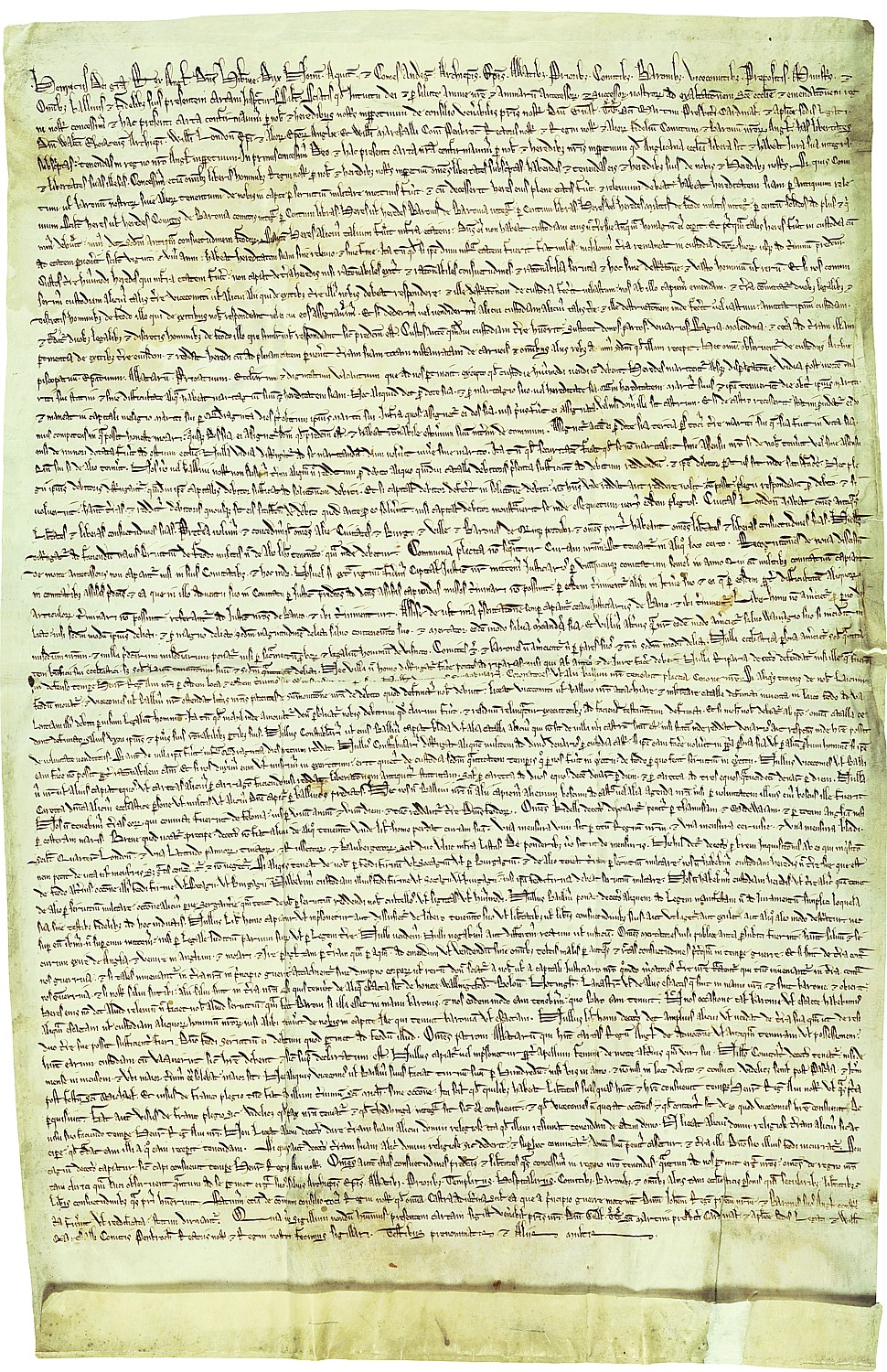
The New-York Historical Society will host the only United States exhibition of a rare 1217 copy of the Magna Carta, Sept. 23-30, 2015, in honor of the 800th anniversary of i the original 1215 signing (c) The Dean and Chapter of Hereford Cathedral from the Library and Archive collections.
A rare early copy of the Magna Carta, one of the most important historical documents in the world, will be on display at the New-York Historical Society for just one week, September 23-30, the only United States appearance and the first stop in a global tour of the Magna Carta, to celebrate the 800th anniversary of the original signing, in 1215.
The document, a 1217 version of the Magna Carta on loan from the Hereford Cathedral, will be accompanied by the King’s Writ of 1215, also on loan from Hereford Cathedral, which is the only known surviving copy of instructions issued by John at Runnymede to local Sheriffs to prepare for the coming of the Charter.
The exhibition, “Magna Carta 800: Sharing the Legacy of Freedom,” at the New-York Historical Societyis the first stop in a global tour of the Magna Carta, in a partnership between Hereford Cathedral and the GREAT Britain Campaign, which will also pass through China (including Hong Kong), Luxembourg, Malta, Portugal, and Singapore.
“The Magna Carta is a hugely important part of our history and stands as a beacon for our values today,” UK Foreign Office Minister Hugo Swire said. “The tour is a fantastic way of enabling people from America to Asia to see it first hand, and to reflect on all that it stands for.”
“We are thrilled to offer New Yorkers a chance to experience the Magna Carta, one of the
most influential historical documents of all time, on the occasion of its 800th anniversary,” said Dr. Louise Mirrer, President and CEO of the New-York Historical Society. “The Magna Carta established fundamental principles that inspired America’s Founding Fathers when they wrote the U.S. Constitution and Bill of Rights, so this seminal document will allow our visitors to trace an important path of history back to its very origins.”
The document that became known as the Magna Carta, or “Great Charter,” was initially developed in 1215 and issued by King John as a peace treaty with rebel barons to address specific grievances of his rule. Although the treaty did not hold, the document established the principle that everyone, even the king, was subject to the law, with all free men granted the right to justice and a fair trial. As such, the document has enormous symbolic power, granting protection against tyrannical rule and defending civil liberties, a central source of inspiration for future constitutional documents.
On view with the Magna Carta at New-York Historical will be an original copy of the King’s Writ, issued on June 20, 1215, by King John to inform the sheriff and other royal officials in each county of the terms of the peace treaty. The 1215 treaty was modified and reissued in subsequent years, in part to garner support for King Henry III, who was just nine years old
when he succeeded the throne in 1216. The 1217 version, which will be on view at New-York Historical, was issued by John’s immediate successor,the young Henry III. and contains significant additions, which would be retained in subsequent reissues of the Charter by English monarchs. Only four copies of the 1217 version survive.
Copies of the Magna Carta have traveled to New York in the past, most notably for the 1939 World’s Fair in Queens, where it was displayed at the British Pavilion. In more recent years, copies of the document have been on view in New York and Washington, D.C., but this is the first time that the Hereford Cathedral copy has traveled to New York.
Follow the progress of the #MagnaCartaTour on Twitter @HFDMagnaCarta and Instagram. Information on Magna Carta and its 800th anniversary is available on the Magna Carta Committee’s website.
New-York Historical Society 170 Central Park West, New York, 10024, 212-873-3400, nyhistory.org.
President Obama went home to Chicago to launch the “Every Kid in a Park” initiative that will provide all fourth grade students and their familieswith free admission to National Parks and other federal lands and waters for a full year.
At the same time, the President announced the creation of three new National Monuments across the country, including the Pullman National Monument in Illinois, a location iconic for its history of labor unrest and civil rights advances, which will be Chicago’s first National Park Service (NPS) unit; Honouliuli National Monument in Hawaii, the site of an internment camp where Japanese American citizens, resident immigrants, and prisoners of war were held captive during World War II, and Browns Canyon National Monument in Colorado, an historic site of extraordinary beauty with world-class recreational opportunities that attract visitors from around the globe.
“Together, these monuments will help tell the story of significant events in American history and protect unique natural resources for the benefit of all Americans,” the White House said.
“No matter who you are, no matter where you live, our parks and our monuments, our lands, our waters — these places are the birthright of all Americans,” President Obama said.
But of the three, the Pullman National Monument has special significance for the President, not just for its importance to the labor movement and the civil rights movement. As he related the story:
“This place has been a milestone in our journey toward a more perfect union,” President Obama said.
“So this site is at the heart of what would become America’s Labor Movement — and as a consequence, at the heart of what would become America’s middle class. And bit by bit, we expanded this country’s promise to more Americans. But too many still lived on the margins of that dream.
“The white workers who built Pullman’s rail cars won new rights. But those rights were not extended to the black porters who worked on these cars — the former slaves, and sons and grandsons who made beds and carried luggage and folded sheets and shined shoes. And they worked as many as 20 hours a day on less than three hours’ sleep just for a couple dollars a day. Porters who asked for a living wage, porters who asked for better hours or better working conditions were told they were lucky to have a job at all. If they continued to demand better conditions, they were fired. It seemed hopeless to try and change the status quo.
“But a few brave men and women saw things differently. And one summer night in 1925, porters packed a hall in Harlem, and a young man there named A. Philip Randolph led the meeting. And what A. Philip Randolph said was, “What this is about,” he said, “is making you master of your economic fate.” Making you master of your economic fate. And so he and others organized the Brotherhood of Sleeping Car Porters around the strategy that he would employ throughout his life: “If you stand firm and hold your ground, in the long run you’ll win.”
“That was easier said than done. Over the years, Brotherhood leaders and supporters were fired, they were harassed. But true to A. Philip Randolph’s call, they stood firm, they held their ground. And 12 years to the day after A. Philip Randolph spoke in that hall in Harlem, they won, and Pullman became the first large company in America to recognize a union of black workers.
“And this was one of the first great victories in what would become the Civil Rights Movement. It wouldn’t be the last victory. It was his union that allowed A. Philip Randolph to pressure President Roosevelt to desegregate the defense industry. It was those Pullman porters who gave the base by which A. Philip Randolph could convince President Truman to desegregate the Armed Forces. It was those porters who helped lead the Montgomery Bus Boycott, who were the central organizers of the March on Washington.
“And that’s not just the story of a movement, that’s the story of America. Because as Americans, we believe that workers’ rights are civil rights. That dignity and opportunity aren’t just gifts to be handed down by a generous government or by a generous employer; they are rights given by God, as undeniable and worth protecting as the Grand Canyon or the Great Smoky Mountains. …
“That’s the story of this place — that, together, we can do great things that we cannot accomplish alone. That’s why today I’m designating Chicago’s Pullman District as America’s newest national monument. I want this younger generation, I want future generations to come learn about their past. Because I guarantee you there are a lot of young people right here in Chicago, just a few blocks away, living in this neighborhood who may not know that history.
“I want future generations to know that while the Pullman porters helped push forward our rights to vote, and to work, and to live as equals, their legacy goes beyond even that. These men and women without rank, without wealth or title, became the bedrock of a new middle class. These men and women gave their children and grandchildren opportunities they never had.
“Here in Chicago, one of those porter’s great-granddaughter had the chance to go to a great college and a great law school, and had the chance to work for the mayor, and had the chance to climb the ladder of success and serve as a leader in some of our cities’ most important institutions. And I know that because today she’s the First Lady of the United States of America, Michelle Obama.
“So to the young people here today, that’s what I hope you take away from this place. It is right that we think of our national monuments as these amazing vistas, and mountains, and rivers. But part of what we’re preserving here is also history. It’s also understanding that places that look ordinary are nothing but extraordinary. The places you live are extraordinary, which means you can be extraordinary. You can make something happen, the same way these workers here at Pullman made something happen. (Applause.)
“Because for all the progress that we’ve made — and we have made a lot of progress — our moral revolution is unfinished. And it’s up to each of us to protect that promise of America, and expand that promise of opportunity for all people. That long march has never be easy. This place, historic Pullman, teaches us we have to keep standing firm and together. That’s the story of who we are. That’s the story of our past. And I have no doubt that we will pass the torch from generation to generation so that it is the story of our future as well.”
Pullman National Monument in Illinois:
This monument will preserve and highlight America’s first planned industrial town, and a site that tells important stories about the social dynamics of the industrial revolution, of American opportunity and discrimination, and of the rise of labor unions and the struggle for civil rights and economic opportunity for African Americans and other minorities. The 203-acre site includes factories and buildings associated with the Pullman Palace Car Company, which was founded in 1867 and employed thousands of workers to construct and provide service on railroad cars. While the Pullman Company employed a mostly white workforce to manufacture railroad passenger cars, it also recruited the first porters, waiters and maids from the population of former slaves to serve on its luxury cars. Though lower-paying, these service jobs held prestige in the African-American community and played a major role in the rise of the African-American middle class and, through an historic labor agreement, the development of the civil rights movement of the 20th Century. The historic labor movement organized by A. Philip Randolph in the 1930s to win rights for these porters, waiters and maids ultimately created the Brotherhood of Sleeping Car Porters, the first labor union led by African Americans to receive a charter in the American Federation.
The National Park Foundation announced that nearly $8 million dollars has already been raised to support the monument, which will be Chicago’s first National Park Service unit and will be managed by the Department of the Interior’s National Park Service (http://pullmanil.org/nps.html).
Browns Canyon National Monument in Colorado:
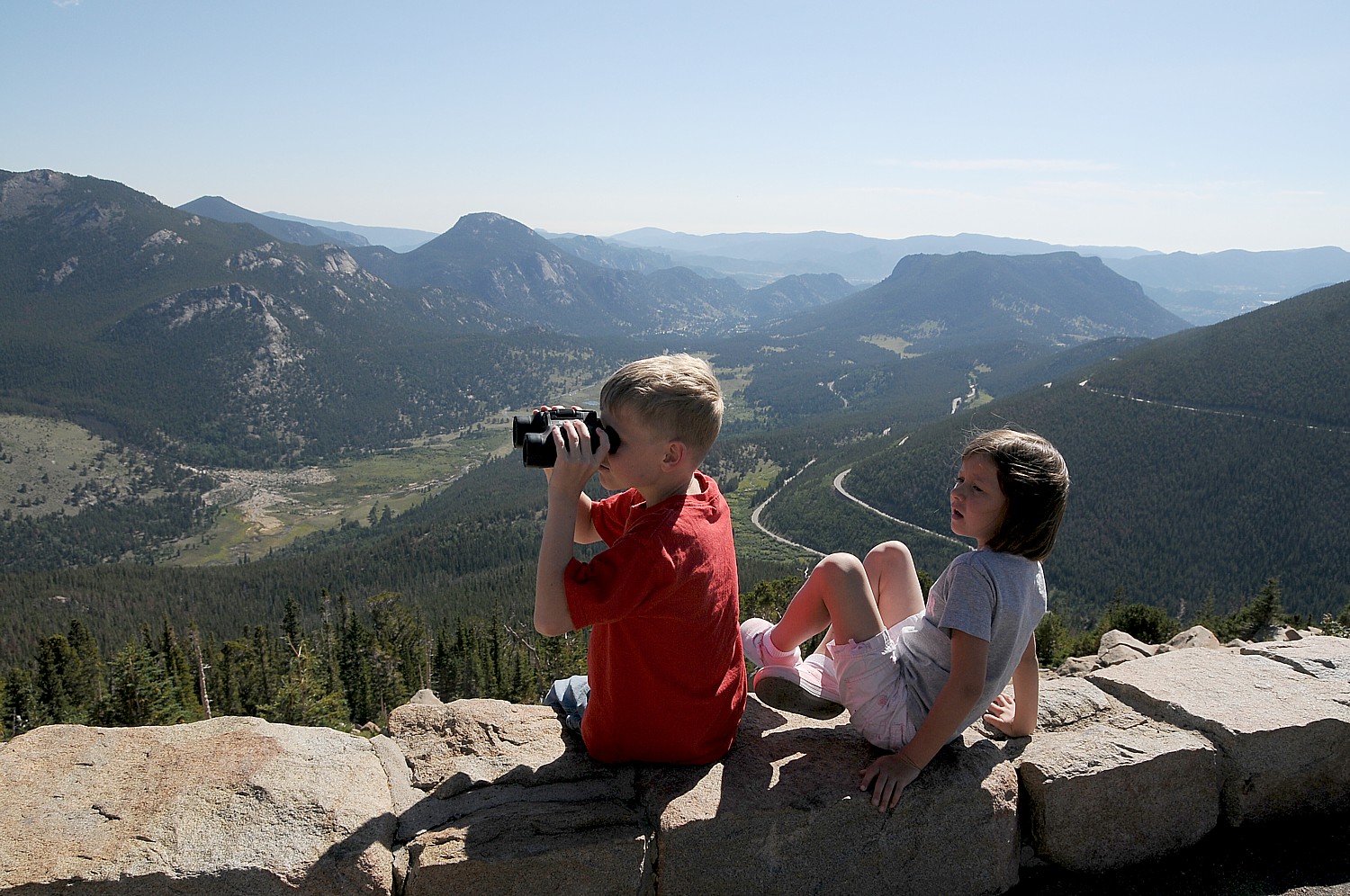
This monument will protect a stunning section of Colorado’s upper Arkansas River Valley. Located in Chaffee County near the town of Salida, Colorado, the 21,586-acre monument features rugged granite cliffs, colorful rock outcroppings, and mountain vistas that are home to a diversity of plants and wildlife, including bighorn sheep and golden eagles. Members of Congress, local elected officials, conservation advocates, and community members have worked for more than a decade to protect the area, which hosts world-class recreational opportunities that attract visitors from around the globe for hiking, whitewater rafting, hunting and fishing. In addition to supporting this vibrant outdoor recreation economy, the designation will protect the critical watershed and honor existing water rights and uses, such as grazing and hunting. The monument will be cooperatively managed by the Department of the Interior’s Bureau of Land Management and USDA’s National Forest Service.
Honouliuli National Monument in Hawaii:
This monument permanently protects a site where Japanese American citizens, resident immigrants, and prisoners of war were held captive during World War II. Located on the island of Oahu, the monument will help tell the difficult story of the internment camp’s impact on the Japanese American community and the fragility of civil rights during times of conflict. Honouliuli Internment Camp, located in a steep canyon not far from Pearl Harbor, opened in March, 1943 and was the largest and longest-used confinement site for Japanese and European Americans and resident immigrants in Hawaii, eventually holding 400 civilian internees and 4,000 prisoners of war. The camp was largely forgotten until uncovered in 2002, and the President’s designation will ensure its stories are told for generations. The monument will be managed by the Department of the Interior’s National Park Service.
Every Kid in a Park
In the lead up to the 100th birthday of the National Park Service in 2016, the President’s Every Kid in a Park initiative is a call to action to get all children to visit and enjoy America’s unparalleled outdoors. \
“Today, more than 80 percent of American families live in urban areas, and many lack easy access to safe outdoor spaces. At the same time, kids are spending more time than ever in front of screens instead of outside. A 2010 Kaiser Family Foundation study found that young people now devote an average of more than seven hours a day to electronic media use, or about 53 hours a week – more than a full time job.
“America’s public lands and waters offer space to get outside and get active, and are living classrooms that provide opportunities to build critical skills through hands-on activities.”
To inspire the next generation to discover all that America’s public lands and waters have to offer, the Obama Administration will provide all 4th grade students and their families free admission to all National Parks and other federal lands and waters for a full year, starting with the 2015-2016 school year. The initiative will also:
Make it easy for schools and families to plan trips: The Administration will distribute information and resources to make it easy for teachers and families to identify nearby public lands and waters and to find programs that support youth outings.
Provide transportation support to schools with the most need: As an integral part of this effort, the National Park Foundation (NPF) – the congressionally chartered foundation of the National Park Service – is expanding and re-launching its Ticket to Ride program as Every Kid in a Park, which will award transportation grants for kids to visit parks, public lands and waters, focusing on schools that have the most need.
Provide educational materials: The initiative will build on a wide range of educational programs and tools that the federal land management agencies already use. For example, NPS has re-launched a website with over 1,000 materials developed for K-12 teachers, including science labs, lesson plans, and field trip guides. And a number of federal agencies, including the Bureau of Land Management, Forest Service, Fish and Wildlife Service, National Oceanic and Atmospheric Administration, Department of Education, and NPS participate in Hands on the Land, a national network of field classrooms and agency resources that connects students, teachers, families, and volunteers with public lands and waterways.
To further support this effort, the President’s 2016 Budget includes a total increased investment of $45 million for youth engagement programs throughout the Department of the Interior, with $20 million specifically provided to the National Park Service for youth activities, including bringing 1 million fourth-grade children from low-income areas to national parks. This increase will also fund dedicated youth coordinators to help enrich children and family learning experiences at parks and online.
‘Conservation, a Truly American Idea’
The President, standing near the site of the historic Pullman town in Chicago, said, “For a century, rangers, and interpreters, and volunteers and visitors have kept alive what the writer Wallace Stegner once called ‘the best idea we ever had’ — our belief that the country’s most special places should belong not just to the rich, not just to the powerful, but belong to everybody — not just now, but for all time.
“Conservation is a truly American idea. The naturalists and industrialists and politicians who dreamt up our system of public lands and waters did so in the hope that, by keeping these places, these special places in trust — places of incomparable beauty, places where our history was written — then future generations would value those places the same way as we did. It would teach us about ourselves, and keep us grounded and keep us connected to what it means to be American. And it’s one of our responsibilities, as Americans, to protect this inheritance and to strengthen it for the future.
“And that’s why I’ve used my authority to set aside more public lands and waters than any President in history. (Applause.) And that’s why, starting next month, we’re going to encourage every American to “Find Your Park,” because chances are, there’s one closer than you think.”
Antiquities Act Under Threat of ‘No New National Parks’ Legislation
The Antiquities Act was first exercised by President Theodore Roosevelt in 1906 to designate Devils Tower National Monument in Wyoming. Since then, 16 presidents have used this authority to protect unique natural and historic features in America, such as the Grand Canyon, the Statue of Liberty, and Colorado’s Canyons of the Ancients.
With these new designations, President Obama will have used the Antiquities Act to establish or expand 16 national monuments. Altogether, he has protected more than 260 million acres of public lands and waters – more than any other President – as well as preserved sites that help tell the story of significant people or extraordinary events in American history, such as Cèsar E. Chàvez National Monument in California, Harriet Tubman Underground Railroad National Monument in Maryland, and Charles Young Buffalo Soldiers National Monument in Ohio.
However, the Republican-led Congress has moved to undermine the President’s authority to designate national monuments.
“Since 1906, presidents of both parties have used this legislation to protect sites, objects, and landscapes of historic, cultural, or scientific interest on federally-owned or controlled property,” the National Trust for Historic Preservation stated. “Some of America’s most iconic places were first protected by presidential national monument designations, including the Statue of Liberty, Grand Canyon and Acadia. Recent designations such as Fort Monroe, the Harriet Tubman Underground Railroad, the César E. Chávez National Monument — and now Pullman — demonstrate just how critical the Antiquities Act is to protecting America’s diverse historic and cultural sites.
“Now, only two months into 114th Congress, seven bills have already been introduced that would weaken, restrict or add burdensome requirements to the president’s use of the Antiquities Act. These bills pose a serious threat to the future preservation of America’s most important and beloved places.”
(See more at National Trust for Historic Preservation, 2600 Virginia Ave. NW Suite 1000, Washington, DC 20037, 202-588-6000, 800-315-6847, PreservationNation.org and SavingPlaces.org.
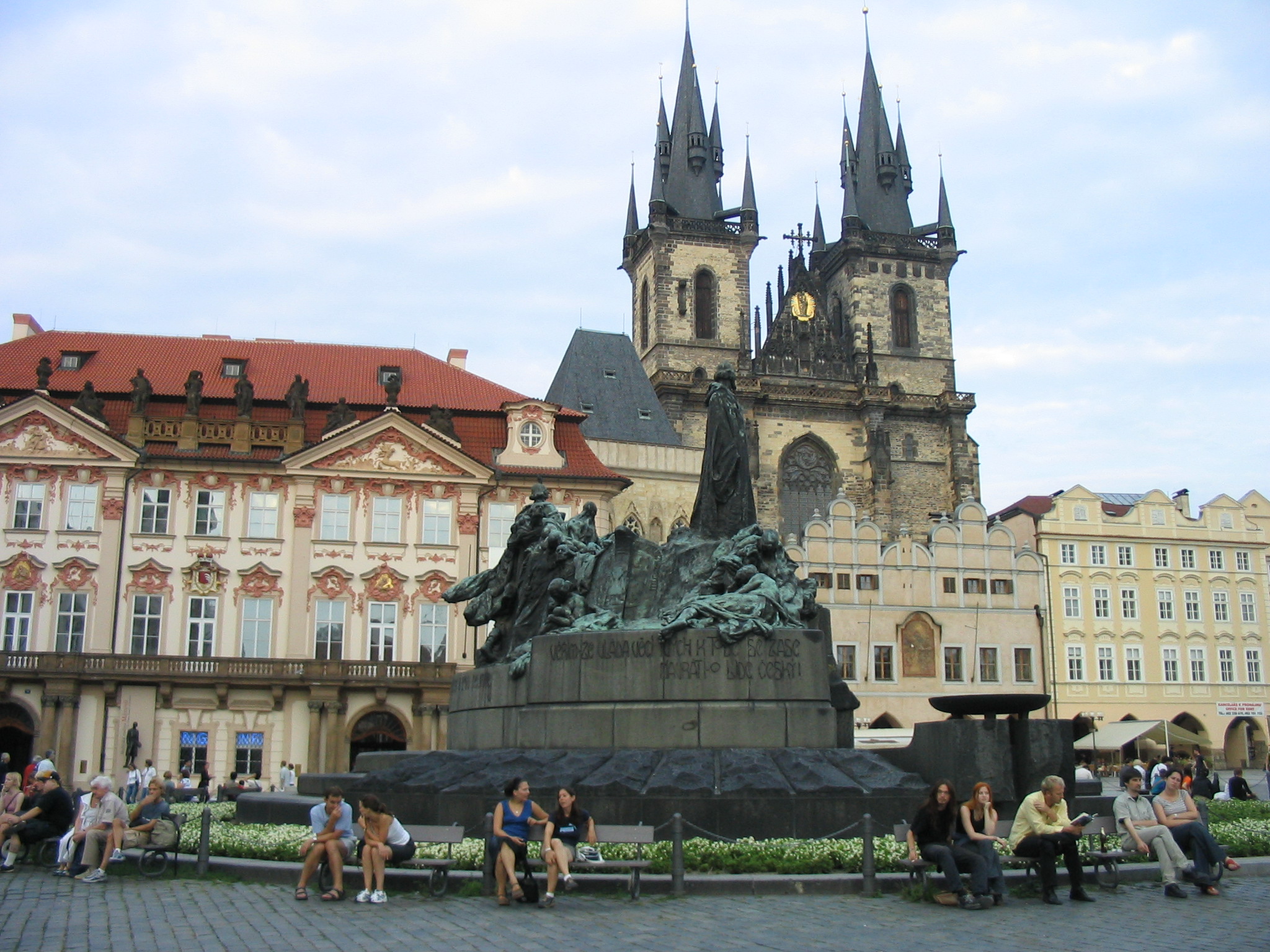
A mission in support of the Jewish communities in Prague and Budapest is being planned (photo by David Leiberman).
BOSTON, MASS. — Members of the Greater Boston Jewish community are organizing a first-of-its-kind upbeat cultural mission designed to show support for the Jewish communities of two of Europe’s great capitals: Budapest, Hungary, and Prague, Czech Republic.
The professionally-led June 16 – 25 mission, “Discovering Our Jewish Past & Present,” is open to all and is being organized by the Temple Israel Brotherhood of Sharon, Mass. under the auspices of Masorti Olami, the World Council of Conservative/Masorti Synagogues. Masorti is devoted to strengthening Jewish life around the world. Space is limited and the reservation deadline is March 15.
Participants will enjoy VIP meetings with community leaders and high-ranking diplomats, 4-star accommodations, sightseeing and guided tours of both cities’ incredible architectural treasures, unforgettable behind-the-scenes experiences with the local Jewish community, and home hospitality.
Co-chairing the mission are Dr. Mark Popovsky, Vice President and Chief Medical Officerat Haemonetics, Inc., and Ron Czik, an IT Development Manager.
“Through meetings with Jewish community leaders, we can become better advocates for their communities, demonstrate ‘Klal Yisrael,’ our solidarity and support,” Dr. Popovsky said, “These proud, self-identifying Jews are bravely staying put. American Jewry has clout on many levels and this is the best way to increase awareness and show the world these communities are alive and well.”
Ron Czik said, “In light of growing worldwide anti-Semitism, this trip takes on even more meaning.” Czik has a special affinity to Hungary as members of his family are Holocaust survivors from Hungary.
Major highlights of the mission include a special Shabbat celebration with the Dor Hadash(‘New Generation’ in Hebrew) Masorti community leaders in Budapest, and VIP meetings to learn firsthand about Hungarian-Jewish relations, in partnership with the American Jewish Committee (AJC).
Besides sightseeing and special programs, the group will engage in advocacy for the safety of the local Jewish community, and leadership development.
In addition to home hospitality with local community leaders and special Sabbath services, other highlights in Budapest will include: Dohany Synagogue; Jewish Museum and Cemetery; cruise on the Danube; Parliament Building; Great Market Hall and more. Among highlights in Prague: Old City and ghetto; historic synagogues and State Jewish Museum; tour of Terezin concentration camp; Holocaust Memorial Day service; and a tour of Golden Prague.
Prague’s Jewish community dates back to the 13th century. Very few Czech Jews survived the Holocaust; a quarter million died at the hands of the Nazis and 60 synagogues were destroyed. Today, about 4,000 Jews reside in the Czech Republic. Hungary’s Jewish community dates back to 895 AD or earlier. Over 600,000 were killed by the Nazis. Today‘s Jewish population is about 120,000, mostly in Budapest, making it one of Europe’s largest. There are many active synagogues in Hungary, including the largest in Europe the second largest in the world.
The mission is a direct outgrowth of the 2011 Men’s Club Biennial Conference where American community leaders were challenged to find ways to connect with young Jewish professionals around the world who are courageously leading their historic communities into the 21st century.
Using Skype, members of Temple Israel of Sharon have celebrated holidays and prayed together with leaders of Dor Hadash. In 2013, Dor Hadash leaders were hosted in Sharon, Mass., during a convention of the Federation of Jewish Men’s Clubs in Boston.
Arrangements for this mission are being made by Ayelet Tours, Ltd., of Albany, NY, which has 30 years of experience creating Jewish travel experiences around the world.
The cost is about $4,500 per person – includes airfare, 4-star hotels for 10 days, guided tours, programs, and many meals.
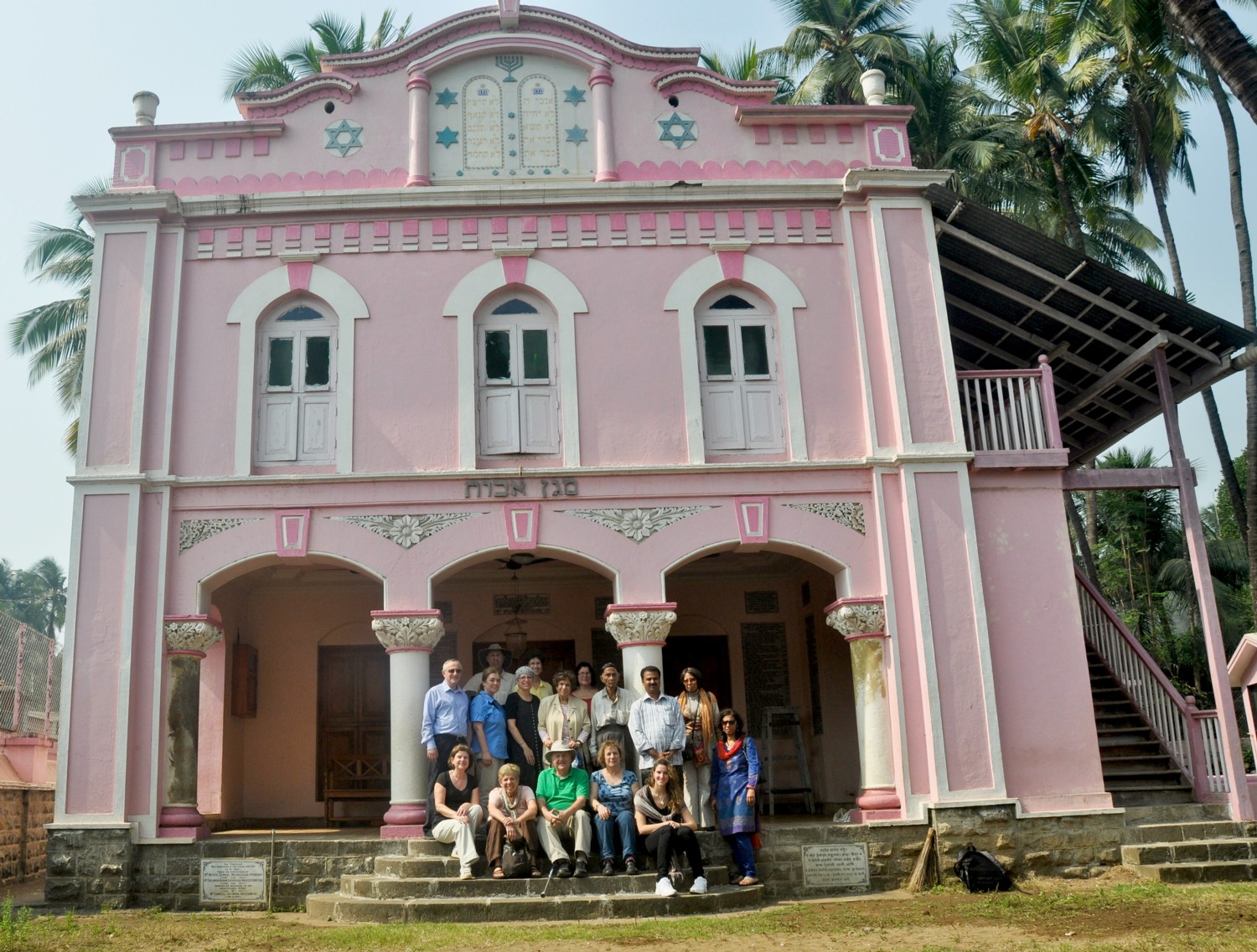
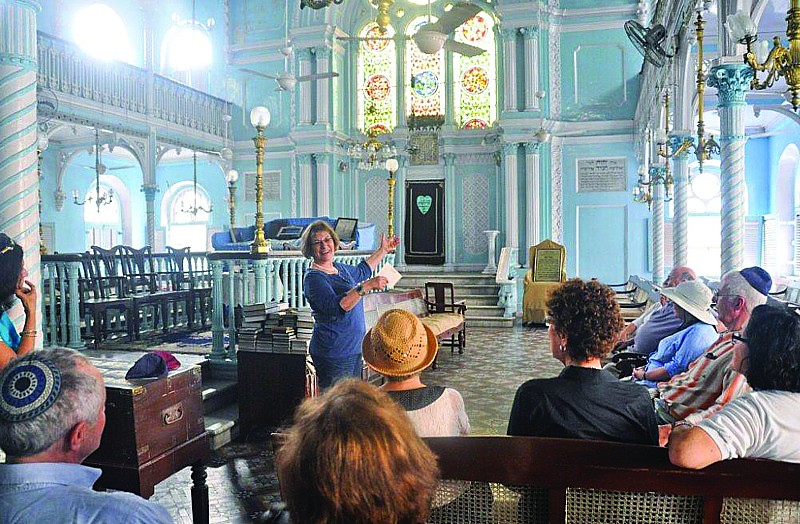
Coming upon a pastel pink synagogue with hot pink trim is only one of the surprises travelers will uncover on Burkat Global’s 3,000 Years of Jewish India tour. In Southern India you’ll walk in the footsteps of the Jews who arrived as spice traders 3,000 years ago and those who settled there.2,000 years ago after the destruction of the second temple.
The journey begins in Mumbai (aka Bombay), India’s most sophisticated city, where you’ll shop in ancient bazaars and visit colonial relics. You’ll also tour breathtaking synagogues and historic sites, take a private boat across Mumbai harbor to visit age-old synagogues and oil pressers on the Konkan Coast, and take another private boat to Elephanta Island to explore early Hindu caves.
A short flight takes the group to Cochin (aka Kochi) and the backwaters of Kerala, “the Venice of the East,” for Ayurveda massage, yoga, or just relaxing. You’ll enjoy a Kathakali performance and traditional Kerala home-style meals. There’s also a lazy afternoon on board a luxury houseboat, dining and taking pictures of villagers fishing, palm-fringed paddy fields and brightly-painted houses and churches.
In the city of Cochin you’ll have a cooking lesson and visit a “secret” synagogue; tour ancient Jew Town’s spice markets, antiques shops, Jewish cemetery and India’s oldest synagogue; view contemporary art on a special tour of the Kochi-Muziris Biennale; and see the Dutch Palace, Vasco da Gama’s church and more. In Muziris, where Jewish traders settled even before Cochin, you can work with archaeologists digging up the past, and swim in the Arabian Sea. You’ll see recently-restored synagogues and an ancient Jewish cemetery in a town where Jews, Hindus, Muslims and Christians have lived peacefully for millennia.
There are about 5,000 Jews left in India, Howard Burkat tells me. “Because no one really knows the exact number, sometimes the number is thought to be as many as 7,500. There were substantially fewer than 100,000 before Israel became a state. Again, an exact and reliable number is very hard to come by. The vast majority of Indian Jews left the country to settle in Israel in the years immediately after that country’s gaining independence in 1948.
The synagogues that remain are in many cases still used as places of worship. They were built in the 17th-19th centuries and most have been used by the community ever since. However, some are in excellent condition. Some need sprucing up. And some are in terrible shape waiting to be restored.
Recently the government of the southern state of Kerala, where the synagogues around Cochin are located, has restored a number of synagogues beautifully, he says. “In fact Dr. Shalva Weil of the Hebrew University of Jerusalem, who is the scholar in residence on our tour and travels with us, was heavily involved in a number of these restorations.”
In Mumbai on the holidays a few hundred people might attend services; out on the Konkan coast in the country outside Mumbai, fewer than a dozen people might worship. In still other synagogues, no one attends – they are museums maintained by government entities.
There is an old, beautiful synagogue, nearly 300 years old, hidden deep in the marketplace in Cochin. It is not visible from the street. You must be led to it through a large pet store and garden center whose Jewish owner will take you through his stores and into the synagogue to tell you its history.
“There are no regular services now, the last rabbi returned to Israel more than two years ago, but on our tour, Sabbath worship will be arranged,” Burkat says., “Travelers sit under chandeliers ordered from Europe in the 1700s, and walk on tile floors from China, each one different from the next, that have been in place for hundreds of years.”
Dr. Shalva Weil of The Hebrew University, considered the world’s leading expert on Jewish India, will be the scholar in residence, traveling with and teaching the group.
Along the way there are delicious meals of Indian food—not hot unless you like it hot—and special Jewish Indian Shabbat dinners. (Note that tour meals are not kosher, but are vegetarian and fish.) Hotels, all green award winners, include the legendary 5-star Taj Mahal Palace in Mumbai, Kerala’s lakeside Coconut Lagoon Resort, which Condé Nast Traveler has called one of the world’s best getaways, and the Brunton Boatyard, which combines 19th-century atmosphere with 21st-century luxury on an historic stretch of Cochin’s celebrated harbor.
There are also opportunities to meet local people. “In Mumbai and Cochin we arrange dinners with local Jewish community leaders. Our ground operator and guides are members of the Bene Israel community in Mumbai – they are leading our group into their own community.”
“3000 Years of Jewish India” makes three stops. In Mumbai and Cochin the group travels to numerous Jewish and non-Jewish sites. “Doctor Shalva Weil explains and lectures on the Jewish sites each day when we are visiting them. We also spend four days at the Coconut Lagoon resort, one of the most luxurious in India. This is a wonderful indulgence stop. There is a chance to learn about the literary heritage of Kerala and also see its famous Kathakali dances. There may be a lecture by Dr, Weill, but there is not Jewish heritage component here as there is in Cochin and Mumbai.
The tour is geared organized by the Burkat family and designed for families.
The small-group, land-only tour costs $7,995 per person, double occupancy, and includes almost everything: accommodation in luxury hotels, all intra-India transportation and transfers, daily breakfast, 21 lunches and dinners, bottled water, sightseeing with entrance fees, the services of expert Indian Jewish guides, taxes and gratuities. There is one departure: January 26, 2015; the tour is limited to 20 people. International air fare is not included.
For more information about the “3,000 Years of Jewish India” tour, visit www.burkatglobal.com. For reservations, call 914-231-9023.