Karen Rubin, Editor & Publisher, is a veteran travel writer and publisher, who is devoted to the mission of travel: to engender understanding – of self and others – and break down the barriers and borders dividing people, while creating the economic underpinnings to sustain environment, heritage and culture and a base for uplifting, fulfilling jobs.
Ray Hamilton, Veteran Ventures: “Vermont Adaptive makes the things you think are impossible, possible. I never thought I would see kids who are blind skiing or biking, but Vermont Adaptive makes it happen.” On top of learning to snowboard, becoming a volunteer snowboarding coach, and getting outside every single week, Ray said that being with Vermont Adaptive has taught him more about himself, and given him a second chance.
KILLINGTON, Vt. —Vermont Adaptive Ski and Sports officials have filed an Act 250 permit application with the state of Vermont to build a new, $2 million adaptive sports facility at Sugarbush Resort’s Mt. Ellen. The application states that Vermont Adaptive is the applicant and Sugarbush Resort is the landowner. If approved, Vermont Adaptive’s Executive Director Erin Fernandez said the organization will break ground on the new facility in the spring.
“We’re in the final stages of our fundraising and are grateful for the continued support from Win Smith, Sugarbush, and its new owner, Alterra, to allow us to build our second adaptive sports facility in the state right here at our home at Mt. Ellen,” said Fernandez. “Friends and participants of Vermont Adaptive’s programs at Sugarbush have pledged a generous challenge to match every dollar up to $1 million for this Sugarbush facility. Sugarbush officials have granted a long term lease of the land necessary to build upon. We saw huge growth in our programs and the number of people who can participate in year-round sports when we built our first adaptive sports facility at Pico Mountain in 2013. We’re excited for the potential growth in the Mad River Valley with this next phase of our Home Sweet Home permanent homes campaign.”
Architectural plans, renderings and permitting began in Spring 2018 for the new 4,000-sq. ft. adaptive sports facility. Plans for the Sugarbush facility were designed by Jeff Dunham Architecture. Fernandez said that in addition to donations from individuals, the organization is seeking in-kind support in the form of building materials and more.
“We are thrilled to be partnering with Vermont Adaptive in their efforts to build a new adaptive sports facility here at Mt. Ellen,” said Win Smith, president of Sugarbush Resort. “We believe in the great work of Vermont Adaptive and provide full support to realize their vision.”
Vermont Adaptive, nationally recognized for its year-round daily adaptive sports programs for people with any disability, has a total goal of $4 million to build, open and sustain this facility at Sugarbush, as well as to build a new permanent home on the Burlington Waterfront and Bike Path, and to create a sustainability fund to support these programs and facilities into the future.
“People with disabilities are more likely to have other health issues like heart disease, stroke, or diabetes which is why it is so important to provide programs for people to be active and live a healthy lifestyle,” said Fernandez. “This new facility allows us to grow and expand our existing programs and to serve more athletes with disabilities in the Mad River Valley and in Central Vermont, for those vacationing in Vermont, and beyond. More programs like wellness and environmental camps, plus retreats, social events, training seminars, and sport specific programs will be added to serve more people. Additional storage and maintenance spaces allow us to increase equipment capacity. The opportunities are limitless. In designing these facilities we thoughtfully consider and include features that focus on inclusion, adaptability and the participant’s overall experience. It’s a special and exciting time for us as we plant permanent roots in Central and Northern Vermont.”
The organization built and opened the Andrea Mead Lawrence Lodge at Pico Mountain in November 2013 with the Pico Ski Education Foundation, marking the completion of the first phase of the Home Sweet Home campaign. This facility houses the organization’s headquarters and is the hub for year-round programming in southern Vermont and the greater Rutland/Killington region. It is one of the only year-round adaptive sports facilities in Vermont and New England.
Vermont Adaptive’s humble beginnings began on the ski trails at Mt. Ascutney more than 30 years ago in 1987. As the organization expanded throughout the state to meet the recreational needs of those with disabilities, it also began summer programs to eventually become a nationally recognized year-round organization.
This is huge for New York State’s tourism and recreational
opportunities: Governor Andrew M. Cuomo’s is proposing a $300 million plan
to reimagine the Erie Canal by creating recreational activities on the Canal to
boost tourism and recreational
fishing, mitigate flooding, enhance irrigation and restore wetlands.
“When the Erie Canal was created in the
19th century it set the state and the nation on a path to
prosperity, and this year we will repurpose the canal to fit our state’s
21st century needs,” Governor
Cuomo said. “This bold and visionary plan to transform
this historic waterway will build on the success of the Empire State Trail (750
miles of connected bikeways), grow tourism across Upstate New York,
improve resilience of today’s Canal communities and ensure the
economic sustainability of the waterway into the future.”
“The canals have played a crucial role in New York’s history and
growth, and with the implementation of these new exciting projects, the canals
will remain a vital force and make a positive contribution to the economic
well-being and quality of life in the 225 communities they travel through,”
said Lieutenant Governor Kathy Hochul.
A first phase of funding starting this year – through the New
York Power Authority Board which oversees the Canal Corporation as a subsidiary
– includes a $100 million economic development fund to invest
in communities along the Canal and a separate $65 million investment
in solutions that will help prevent ice jams and related flooding in the
Schenectady area.
The remaining $135 million of the plan’s funding will subsequently be allocated
to research recommended by the Reimagine Task Force, as well
as to solutionsrelated to flood mitigation,
invasive species prevention and ecosystem restoration.
New Economic Development Fund for Canal Communities
In the first phase of the program, a $100 million economic
development fund will support projects that adaptively reuse canal
infrastructure to enhance water recreation, tie the Canal’s new
recreational improvements to the Governor’s Empire State Trail,
celebrate historic canal structures, and develop unique canalside
attractions and activities. Roughly $25 million of that will be allocated
immediately to a set of initial projects:
Connecting Communities: The “Brockport Loop” project in Monroe County will
connect SUNY College at Brockport to the Empire State
Trailand the village of Brockport through
the transformation of a canal guard-gate into a
pedestrian bridge and overlook, with a supporting grant of $2 million
from the Ralph Wilson Foundation.
Celebrating “Iconic Infrastructure”:Interactive, hydro-powered illumination of Canal “movable
dams” – initially in
Amsterdam and Canajoharie in the
Mohawk River valley – will celebrate the Canal’s
heritage and its history as an engineering marvel.
Expanding Water Recreation: A new whitewater destination, at the north end of Cayuga Lake near Seneca
Falls, will rely on existing water control infrastructure to construct an
active water sports course adjacent to the Montezuma National
Wildlife Refuge, to increase eco-tourism and sport visitors to the region.
Adapting Industrial Property for New
Uses: Winner of the Reimagine the Canals competition,
a canalside pocket neighborhood, will be developed by Madison
County in Central New York at a former industrial
property in Canastota along the Old Erie Canal –
demonstrating a new model for 21st century canalside living.
Developing Destination Accommodations: The
historic Guy Park Manor, on the Mohawk River in
Amsterdam, will be reborn as a hospitality destination and a
pedestrian bridge constructed
across the already-existing Canal lock will provide
access to additional overnight accommodation along the Empire
State Trail on the opposite side of the river.
World-Class Fishing and Restored Wetlands
To create world-class fishing in Western New York, the new
plan recommends managing water releases from the Canal to enhance fish
habitat, improve angling opportunities, and extend the fall fishing season in
Lake Ontario tributaries. It also includes funding to expand public
fishing access along key streams in Orleans, Monroe and Niagara
Counties. In addition, it identifies a program to divert Canal water to restore and
re-nourish wetlands in Central New York that were compromised a
century ago by the Canal’s construction. This will allow areas in
close proximity to the Montezuma National Wildlife Refuge, a migratory
stopover for more than 1 million birds each
year, to be significantly enhanced to further
attract naturalists, locals, and visitors from throughout the region and
beyond.
Ideas in this plan originated from the Reimagine the
Canals Task Force recommendations, launched by
Governor Cuomo in May of 2019 to pursue a
comprehensive investigation of how the 195-year-old Erie Canal
could be reimagined for the 21st century. The Reimagine
the Canals Task Force Report was just released.
The Task Force engaged with municipal leaders, stakeholders, local
business owners, scientists and other experts, along with community
members, to identify opportunities and solutions that support a
new vision for future investments in the waterway. Many of the ideas that the
Task Force explored came from the completed Reimagine the Canals competition, held
last year by the New York Power Authority and New York State Canal
Corporation. SUNY’s Rockefeller Institute of Government, on behalf of
the Task Force, conducted a series of outreach sessions during the summer
in five canal communities – Lockport, Brockport, Schenectady, Utica and
Syracuse – to solicit new ideas from the public at large. Ideas were also
solicited on a Reimagine the Canals website, offering more
distant canal users an opportunity to provide their views to the Task Force.
The “Reimagine” initiative builds on successful
efforts by Governor Cuomo to invest in the canal corridor, including
the state’s Downtown Revitalization Initiative and successful Taste NY program, which have stoked new industries,
businesses and housing in canal communities. Harnessing the Canal’s full
potential to attract more tourism and recreation is a key focus of the
Initiative. Governor Cuomo and state agency and authority staff
will collaborate with Empire Line communities and continue to consult with
Task Force members and other stakeholders to ensure the success
of projects as they move forward.
There are 1.6 million trips taken annually on the Erie Canal Trailway,
the former towpath used by mules and horses to pull barges in the canals’ early
days. The Trailway is part of Governor Cuomo’s Empire State Trail,
which at 750 miles will be the largest state multi-use trail network when
completed in late 2020. Governor DeWitt Clinton began work on the original
Erie Canal on July 4, 1817.
In addition to investing $300 million in the Canal System, there are
also plans to create two new state parks in the
Hudson Valley, add 4,000 acres of land to parks and introduce a $3 billion
“Restore Mother Nature” bond act.
Meanwhile, registration has opened for the
22nd Annual Cycle the Erie, eight-day 400-mile, fully supported biking/camping
trip, from Buffalo to Albany, operated by Parks & Trails NY, taking place
July 12-19, 2020. For information on
Cycle the Erie Canal, call Parks & Trails New York, 518-434-1583, email eriecanaltour@ptny.org or visit www.ptny.org/cycle-the-erie-canal.
Williston, VT –By 2030, 1.8 billion people – about 20 percent of the global population – are predicted to be tourists traveling the world. As the demand for global travel increases, consumers are faced with numerous decisions on how to make their trips more sustainable, including where to go, what to pack and how to get there. Country Walkers, a leading provider of walking adventures and a leader in responsible tourism for decades, offers travelers the opportunity to contribute to a more sustainable world through preserving indigenous cultures, supporting local economies, conserving wildlife and protecting the environment.
“At Country Walkers, we are committed to a healthier planet
and to giving back to the destinations we explore,” said Timo Shaw, President of Country Walkers. “Sustainability is one of our core values, from staying in locally
owned and operated hotels whenever possible and seeking out environmentally and
socially responsible accommodations, to our ardent support of the Slow Food
movement in order to preserve culinary traditions and support biodiversity. As
a result, those who travel with us contribute to a more sustainable world as
well.”
To further support special conservation and charitable
projects in communities and habitats worldwide, Country Walkers created The
Travelers Fund, which makes a donation on behalf of every traveler who
books a specific tour. More than half of Country Walkers’ tours are associated
with an initiative, including:
Mountain Rescue at Club Alpino Italiano (Country Walkers tour: Italy: The Amalfi Coast & Capri). Safety comes first
on the Amalfi Coast with a donation to the local mountain rescue team, which
primarily relies on volunteers and donations to obtain and maintain equipment
for rapid emergency response for visitors and locals.
Wildlife Conservation in the Rocky
Mountains (Country Walkers tours: Montana: Glacier National Park and Wyoming: Grand Teton & Yellowstone[KG1] ). The Yellowstone to Yukon
Conservation Initiative seeks to re-connect segments of land that have been
separated by development, allowing animals to safely move from region to region
on wildlife-friendly highway overpasses. Contributions are used towards
constructing one of these wildlife structures.
Therapeutic Travel for Cancer Survivors
in Quebec (Country Walkers tour: Quebec: Quebec City & the Saguenay Fjord). Country Walkers supports the Fondation Sur La Pointe des Pieds
(“On the Tip of the Toes”), which provides young people ages 14 to 29 living
with cancer with an opportunity to regain their sense of well-being through
therapeutic adventure expeditions.
Assisting Pilgrims on Camino de
Santiago (Country Walkers tour: Spain: Classic Camino de Santiago). The
Federación Española de Asociaciones de Amigos del Camino de Santiago
coordinates a vast national network of hostels, volunteers, parishes, churches
and shelters in an effort to keep more than 200,000 pilgrims safe, healthy and
informed as they walk the Camino de Santiago.
Clean Water in Zambia (Country Walkers tour: Zambia Safari: Exclusive Camps & Bush Walks). In Africa, currently 345 million people live without access to
clean drinking water. Together with local partners in Zambia at Charity Begins
Home, Country Walkers supports the “Commit to Clean Water” Fund, an initiative
that seeks to transform rural communities by drilling wells into deep aquifers
and pumping potable water to the surface.
Maintaining the Long Trail in
Vermont (Country Walkers tour: Vermont: Fall Foliage). A highlight of the tour is walking
along one of the most spectacular portions of the legendary 270-mile Long
Trail, the nation’s first long-distance hiking trail. Country Walkers supports
the Green Mountain Club, the stewards of this “footpath through the
wilderness,” who also promote conservation of and education about Vermont’s
mountains and rural land.
Advocacy for Small Businesses in
Palermo (Country Walkers tour: Italy: Sicily). Country Walkers supports the nonprofit
Addiopizzo movement, a grassroots coalition of over 850 shopkeepers aimed at
squashing corruption in Sicily and educating locals about ethical business
practices.
Conserving a Historic Chapel in
Monterosso (Country Walkers tour: Italy: Portofino & Cinque Terre[KG2] ). In 2013, severe landslides destroyed the grounds of the
historic Convento dei Cappuccini chapel and monastery. “Let’s Rebuild
Monterosso’s Paradise” raises funds for the restoration, a cost far beyond the
modest means of the town or diocese.
Cornwall Coastal Preservation (Country Walkers tour: England: The Cornwall Coast). The South West
Coast Path Association advocates for improvements to more than 630 miles of
this historic coastal trail system. As maintenance is costly, donations from
Country Walkers on behalf of guests help maintain these paths that are
heavily utilized on the tour.
Farming for the Future (Country Walkers tours: Portugal: Sintra, Óbidos & the Coast and Portugal: Porto to Lisbon). The Herdade do
Freio do Meio farm applies principles of sustainability within the context
of the Portuguese montado, a traditional pastoral agricultural system in which
reducing reliance on fossil fuels and marketing regionally to provide fresh
foods and minimize transport costs are key policies. The farm processes and
sells many products on site, providing training and employment for locals.
Campobello Whale Rescue Team (Country Walkers tour: New Brunswick: Bay of Fundy & Campobello Island). Created by Mackie Green, the same captain who offers a whale
watching excursion and boat transfers on the Country Walkers tour, the team is
trained to dive and rescue whales trapped in fish netting. Donations support
equipment and training.
Area of Outstanding Natural
Beauty (Country Walkers tour: England: The Cotswolds). Stretching over
790 square miles, the Cotswolds is the largest recognized Area of Outstanding
Natural Beauty in England due to its breathtaking scenery and rolling hills.
Country Walkers supports efforts to keep the area well-preserved on behalf of
every Cotswolds guest.
For more than 40 years, Country Walkers has provided active, experiential, and stunning travel experiences on five continents. Based in Williston, Vt., the company’s specialized adventures and insider access bring the beating heart of a destination to life with well-crafted itineraries for Guided Walking and Self-Guided Walking. All walking trips highlight local cuisine, authentic accommodations, and immersive cultural experiences. Country Walkers is recognized as one of the leading providers of Walking Adventures worldwide, having garnered countless awards including National Geographic Traveler’s “50 Tours of a Lifetime” and Travel + Leisure’s “World’s Best” Awards.
Choctaw Nation Constitution of 1838 / The Constitution and Laws of the Choctaw Nation Park Hill, Cherokee Nation: John Candy, 1840. Photo credit: Ardon Bar-Hama
Herman Hollerith’s Punched Card Tabulator. Scientific American, vol. 63., no. 9. New York, 1890. Courtesy of David M. Rubenstein
Free Admission to Civics Exhibitions for College Students Through 2020
NEW YORK, NY – As election year 2020 begins, the New-York Historical Society launches a series of special exhibitions that address the cornerstones of citizenship and American democracy. Starting on Presidents’ Day Weekend, visitors to Meet the Presidents will discover how the role of the president has evolved since George Washington with a re-creation of the White House Oval Office and a new gallery devoted to the powers of the presidency. Opening on the eve of Women’s History Month, Women March marks the centennial of the 19th Amendment with an immersive celebration of 200 years of women’s political and social activism. Colonists, Citizens, Constitutions: Creating the American Republic explores the important roles state constitutions have played in the history of our country, while The People Count: The Census in the Making of America documents the critical role played by the U.S. Census in the 19th century—just in time for the 2020 Census.
To encourage first-time voters to learn about our nation’s history and civic as they get ready to vote in the presidential election, New-York Historical Society is offering free admission to these exhibitions to college students with ID through 2020, an initiative supported, in part, by The History Channel. This special program allows college students to access New-York Historical’s roster of upcoming exhibitions that explore the pillars of American democracy as they prepare to vote, most of them for the first time.
“The year 2020 is a momentous time for both the past and future of American politics, as the centennial of the 19th Amendment, which granted women the right to vote, coincides with both a presidential election and a census year,” said Dr. Louise Mirrer, president and CEO of New-York Historical. “This suite of complementary exhibitions showcases the ideas and infrastructure behind our American institutions that establish and protect our fundamental rights to make our voices heard and opinions count. We hope that all visitors will come away with a wider understanding of the important role each citizen plays in our democracy.”
Meet the Presidents (February 14 – ongoing) Opening on Presidents’ Day Weekend, a special permanent gallery on New-York Historical’s fourth floor features a detailed re-creation of the White House Oval Office, where presidents have exercised their powers, duties, and responsibilities since 1909. Visitors to New-York Historical can explore the Oval Office, hear audio recordings of presidential musings, and even sit behind a version of the President’s Resolute Desk for a photo op.
Presidents can furnish the Oval Office to suit their own tastes, and this re-creation evokes the decor of President Ronald Reagan’s second term, widely considered a classic interpretation of Oval Office design. The Resolute Desk, which has been used by almost every president, was presented by Queen Victoria of England in friendship to President Rutherford B. Hayes in 1880. The original was made from timbers from the British Arctic explorer ship H.M.S. Resolute, which was trapped in the ice, recovered by an American whaling ship, and returned to England. Other elements reminiscent of the Reagan-era on view include a famous jar of jelly beans, an inspirational plaque reading “It can be done,” and artist Frederic Remington’s Bronco Buster bronze sculpture of a rugged cowboy fighting to stay on a rearing horse.
The Suzanne Peck and Brian Friedman Meet the Presidents Gallerytraces, through artwork and objects, the evolution of the presidency and executive branch and how presidents have interpreted and fulfilled their leadership role. Highlights include the actual Bible used during George Washington’s inauguration in 1789 and a student scrapbook from 1962 chronicling JFK’s leadership during the Cuban Missile Crisis. Meet the Presidents is curated by Marci Reaven, vice president of history exhibits, and Lily Wong, assistant curator.
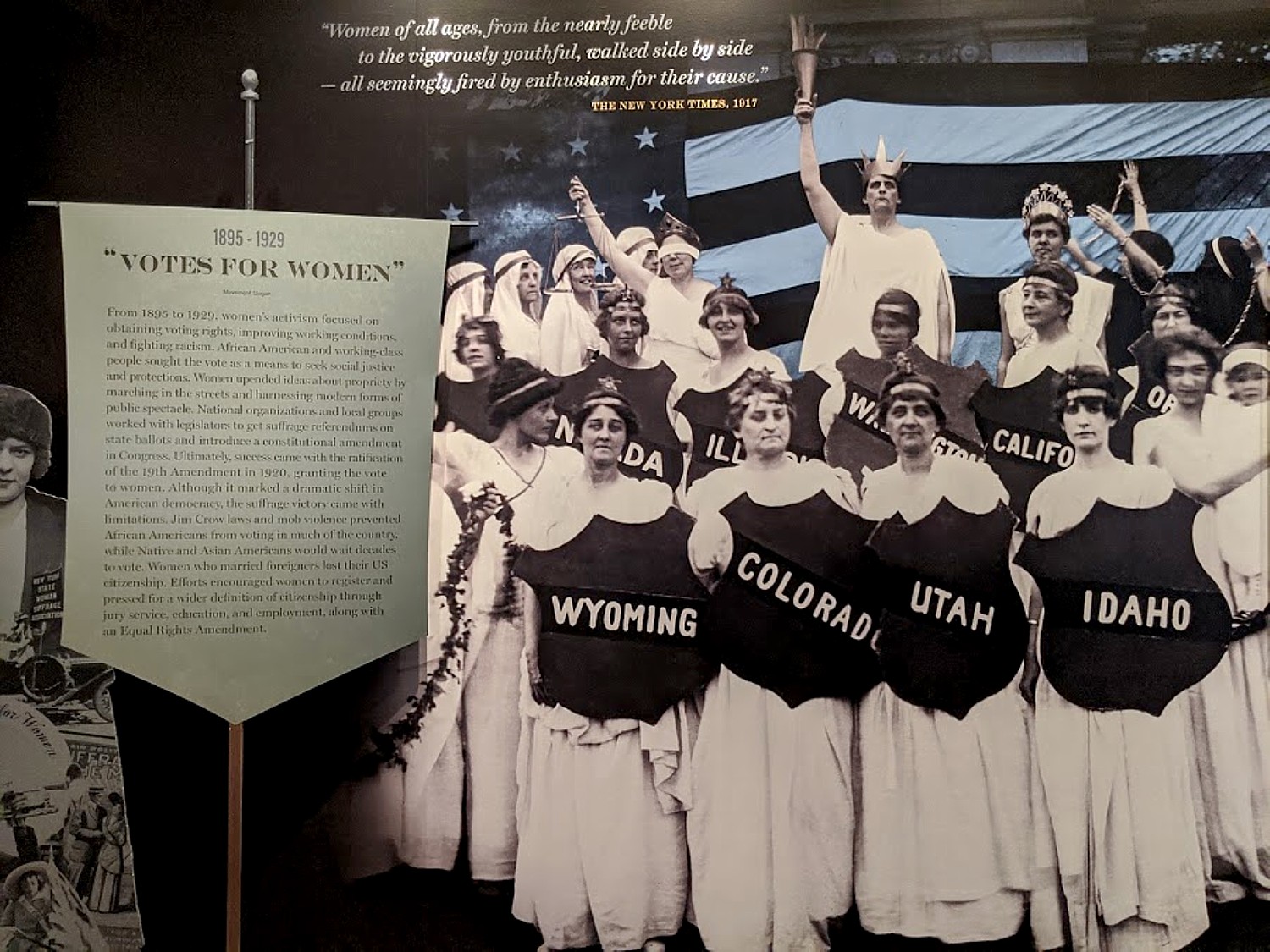
Women March (February 28 – August 30) For as long as there has been a United States, women have organized to shape the nation’s politics and secure their rights as citizens. Their collective action has taken many forms, from abolitionist petitions to industry-wide garment strikes to massive marches for an Equal Rights Amendment. Women March celebrates the centennial of the 19th Amendment—which granted women the right to vote in 1920—as it explores the efforts of a diverse array of women to expand American democracy in the centuries before and after the suffrage victory. On view in the Joyce B. Cowin Women’s History Gallery, Women March is curated by Valerie Paley, the director of the Center for Women’s History and New-York Historical senior vice president and chief historian, with the Center for Women’s History curatorial team. The immersive exhibition features imagery and video footage of women’s collective action over time, drawing visitors into a visceral engagement with the struggles that have endured into the 21st century.
The exhibition begins with the many ways women asserted political influence long before they even demanded the vote. Objects and images demonstrate how they risked criticism for speaking against slavery, signed petitions against Indian Removal, raised millions to support the Civil War, and protested reduced wages and longer days. A riveting recreation of an 1866 speech by African American suffragist and activist Frances Harper demonstrates the powerful debates at women’s rights conventions. Absence of the vote hardly prevented women from running for political office: one engaging item on display is a campaign ribbon for Belva Lockwood, the first woman to argue before the Supreme Court, who won around 4,000 votes in her own presidential bid.
Multiple perspectives on the vote, including African American and working-class activism, are explored, upending popular assumptions that suffragists were a homogenous group. The 19th Amendment is hailed as a crucial step forward, but recognized as an incomplete victory. One photograph shows an African American women’s voter group in Georgia circa 1920, formed despite wide disenfranchisement, and another shows women of the League of Women Voters who sought to make suffragists’ goals real with legislation that addressed issues such as public health and child welfare. A digital interactive monitor invites visitors to explore the nuances of voting laws concerning women across the entire United States.
Offering an examination of women’s activism in the century after the Amendment, the exhibition concludes by showing how women engaged with issues such as safe workplaces, civil rights, reproductive justice, and freedom from violence. Photographs and video footage of women building warships, boycotting segregation, urging voters to register, and marching for the Equal Rights Amendment convey the urgency of their desire for full citizenship. The dynamism of women’s collective action continues to the present day with handmade signs from the 2017 Women’s Marches and footage of a variety of marches and speeches on topics ranging from reproductive justice to indigenous peoples’ rights to climate change. Visitors can also learn about many individuals who have been instrumental in women’s activism over the past 200 years in an interactive display compiled by New-York Historical’s Teen Leaders program. Meanwhile, young visitors can explore the exhibition with a special family guide.
Colonists, Citizens, Constitutions (February 28 – May 31) America has been singular among nations in fostering a vibrant culture of engagement with constitutional matters and the fundamental principles of government. Featuring more than 40 books and documents from the Dorothy Tapper Goldman Foundation’s collection, Colonists, Citizens, Constitutions: Creating the American Republic illuminates America’s continuing debates on the role and limits of government and the fundamental rights of all citizens. From the early days of the American Revolution, to the American Civil War, to the eve of World War I, the rare and early printings of state and federal constitutions trace defining moments in American history and are testaments to our nation’s continuing experiment in self-government and the relentless quest for improvement.
Among the highlights on view is a rare example of the original Dunlap and Claypoole 1787 printing of the U.S. Constitution—one of few surviving copies. Manuscripts, such as the first known description of the Great Seal of America from 1782 and a certified 1802 handwritten copy of the 12th Amendment that altered the system for electing the president and vice president are also on view. The Choctaw Nation Constitution of 1838, written by members of the tribe forcibly relocated from Mississippi to Oklahoma, combines American constitutional forms with traditional practices in an effort to preserve self-government and prevent further violations of their fundamental rights. The Constitution of the Republic of Texas (1836) sanctioned slavery and led the United States to initially decline Texas’ requests for annexation; the inclusion of slavery in the Missouri Constitution of 1820 also led to a bitter fight in Congress to deny Missouri admission to the union. The progressive Louisiana Constitution of 1868 of the Civil War Reconstruction period prohibited segregation of schools by race. Kansas was the first of more than 30 states to prohibit alcohol with the Kansas State Prohibition Amendment of 1880, eventually leading to national Prohibition through the 18th Amendment in 1919. The Wyoming Constitution of 1889 declared that “male and female citizens” could exercise all rights equally, including the right “to vote and hold office”—three decades before federal ratification of the 19th Amendment. The bilingual New Mexico Constitution of 1910—Constitution of the State of New Mexico/Constitucion del Estado de Nuevo Mexico—guaranteed that all laws, including the constitution, would be published in both English and Spanish for at least 20 years.
Colonists, Citizens, Constitutions: Creating the American Republic also includes a selection of songs from WNYC’s Radio Lab “27: The Most Perfect Album,” in which contemporary musicians were asked to interpret the 27 amendments of the U.S. Constitution’s Bill of Rights in their own distinctive style with original new music. Musicians include Flor de Toloache, Sons of an Illustrious Father, Nana Grizol, Dolly Parton, and Caroline Shaw. The full album was conceived by the podcast More Perfect, a production of WNYC Studios, and is available for free online.
This exhibition is the first public viewing of these selected historical documents together, and after its run at New-York Historical, it travels to the Museum of the American Revolution in Philadelphia (June 12 – July 5, 2020). Curated by James F. Hrdlicka of Arizona State University with Michael Ryan, New-York Historical vice president and Sue Ann Weinberg director of the Patricia D. Klingenstein Library, the exhibition is accompanied by a fully illustrated catalogue written by Dr. Hrdlicka, with a foreword by Associate Justice of the Supreme Court of the United States Ruth Bader Ginsburg, and with contributions by Dorothy Tapper Goldman and Robert McD. Parker.
The People Count: The Census in the Making of America (March 13 – June 7) What does it mean to be counted? As the 2020 Census kicks off, The People Count: The Census in the Making of America from the David M. Rubenstein Americana Collection provides an in-depth look at the origins and story of the U. S. Census from 1790 through the 1800s, using 30 books and manuscripts that reveal the critical role the Census played in the development of the country. America became the first country to count its inhabitants for reasons of governing, as it dictates the number of House of Representatives seats that each state gets. In the 19th century as the country grew, so did the stakes of the census process, which further drove our nation west—and to war with itself.
The 2020 census will be the 24th decennial count undertaken without fail for 230 years. Censuses before the Constitution were the charge of the Board of Trade, which sent questionnaires to every colonial governor. “The Present State of the British Colonies in America” on display transcribes the results from 1773 to 1775, just as the American Revolution began, describing the people and land that England controlled at the time. On March 1, 1790, the First Census Act passed. The first census took 18 months to finish and counted almost 4 million people. Thomas Jefferson, then secretary of state, improvised a 56-page report, signing and circulating it privately, a copy of which is on view.
The People Count pays particular attention to the problem of the Three-Fifths Compromise, the census-related clause in the Constitution that regarded slaves equal to 60% of freepersons. Unable to vote, enslaved people unwittingly added to the political representation of slaveholders. Displayed in the exhibition is the 1860 census, which counted 3.95 million slaves, an eighth of all Americans, and uncovered that in 10 years the North had gained 41% more people while the South grew by only 27%. On view are printings of the Emancipation Proclamation and the Ninth Census—Volume I, The Statistics of the Population of the United States, the 1870 census, when there was no longer slaves to be counted for the first time in nine censuses.
In the wake of the Civil War as the population grew and expanded west, the 1880 census reports took eight years to finish. An 1890 copy of Scientific American illustrates how the counting was accomplished in less time with the Punched Card Tabulator system invented by Herman Hollerith, a former census employee from Buffalo, New York. Divided into four devices for perforating, reading, and sorting, workers completed 62.9 million returns of 30 questions in less than five years.
The People Count: The Census in the Making of America is curated by Mazy Boroujerdi, advisor to the David M. Rubenstein Americana Collection, and by Michael Ryan, New-York Historical vice president and Sue Ann Weinberg director of the Patricia D. Klingenstein Library.
Programming
Historians and scholars engage in a slate of related conversations, lectures,
and intimate salons throughout the winter and spring. Black women and the 19th
Amendment (March 12), older women in American history (March 19), and the life
of Harriet Tubman (April 14) are among the topics explored during Women
March. Programs that focus on the spirit of the law and the separation of
powers (April 30), foreign influence in the 2020 election (May 2), and the
presidents vs. the press (May 21) illuminate the presidency and the importance
of the Oval Office. Scholars discuss power, politics, and madness (February 22)
and the enduring constitutional vision of the Warren Court (April 25), among
other programs focused on civics.
Family programs that take place on select weekends throughout the exhibitions’
run bring history to life for young visitors. One of the highlights is
International Women’s Day on Sunday, March 8, when families can make crafts and
meet historical interpreters portraying famous and little known leaders of the
women’s rights movement.
The New-York Historical Society, one
of America’s preeminent cultural institutions, is dedicated to fostering
research and presenting history and art exhibitions and public programs that
reveal the dynamism of history and its influence on the world of today. Founded
in 1804, New-York Historical has a mission to explore the richly layered
history of New York City and State and the country, and to serve as a national
forum for the discussion of issues surrounding the making and meaning of
history. New-York Historical is also home to the Patricia D. Klingenstein
Library, one of the oldest, most distinguished libraries in the nation—and one
of only 20 in the United States qualified to be a member of the Independent
Research Libraries Association—which contains more than three million books,
pamphlets, maps, newspapers, manuscripts, prints, photographs, and
architectural drawings.
The New-York Historical Society is located at 170 Central Park West at Richard
Gilder Way (77th Street), New York, NY 10024. Information: (212) 873-3400.
Website: nyhistory.org. Follow the museum on social media at @nyhistory on Facebook, Twitter, Instagram, YouTube and Tumblr.
Gondwana Ecotours is introducing a new 10-day camping safari in Tanzania. Guests will visit four national parks (Arusha, Tarangire, Ngorongoro Crater & Serengeti), get to know the Maasai Tribe, photograph amazing landscapes, spot the Big Five (lion, leopard, rhino, buffalo, and elephant), and explore dense jungles.
(New Orleans, LA) — Gondwana Ecotours is introducing a
new 10-day camping safari in Tanzania. Guests will visit four national parks
(Arusha, Tarangire, Ngorongoro Crater & Serengeti), get to know the Maasai
Tribe, photograph amazing landscapes, spot the Big Five (lion, leopard,
rhino, buffalo, and elephant), and explore dense jungles. This trip
is full of culture and opportunities for wildlife viewing and photography.
There will be a maximum of 18 guests on the tours, scheduled for July
13-22, 2020 and August 8-17, 2020 starting at $2,995 USD per person not
including international flights
“This is a once-in-a-lifetime safari with
extraordinary wildlife viewing opportunities,” said Gondwana Ecotours
Founder, Jared Sternberg. “We also pay Carbon Offsetting for each
guest and donate to the Maasai Community Development Initiative on their
behalf.”
One of the major highlights of this safari is visiting the Maasai, one of
Africa’s most famous and historic tribes. Travelers will sing and dance with
members of the tribe and tour a traditional hut. Another
unforgettable moment is exploring the Ngorongoro Crater at sunrise before
the crowds arrive. It is home to many lions and some of the last black rhinos
in the world.
“We will enjoy picturesque picnic lunches in the parks near hippo pools,
giraffes, baobab trees and beautiful lakes,” said Sternberg.
“This safari is full of amazing wildlife and culture, and offers an
opportunity to witness one of the most spectacular mass migrations on the
planet.”
What’s Included in the Tanzania Camping Safari Ecotour:
All accommodations and equipment (4 nights at hotel, 5
nights camping)
All meals except for arrival and departure days
All National Park entrance fees in Tanzania (Arusha,
Tarangire, Ngorongoro Crater & Serengeti)
Unique activities with the Maasai tribe (dancing, singing,
home tour and cultural exchange)
Guaranteed window-seat in a private Toyota Land Cruiser with
a local guide/driver
Carbon Offsetting for each guest and donations to the Maasai
Community Development Initiative
Chef-prepared meals and clean drinking water throughout the
safari
All activities and excursions, including safaris and guided
hikes
There has been much discussion of late of the negative
impacts of over-tourism on communities and the environment. But the travel
industry, which offers a lifeline to communities trying to preserve their
heritage and environment by providing an economic foundation, is working
aggressively to reduce these adverse effects. In addition to introducing
sustainable practices in lodging and touring (getting rid of single-use
plastic, promoting farm-to-table dining and local services, reducing impacts on
water and energy supplies) and transportation (introducing technology to reduce
carbon emissions, increase efficiencies), there are other things that travelers
can do to travel responsibly:
Investigate your destinations before
you travel to see if there is a problem with overtourism.
Consider not visiting a destination
suffering from overtourism during the height of its tourism season. Instead,
try to travel in shoulder or off seasons when there are fewer visitors.
Or, travel to less popular destinations
in Europe that offer many similar experiences and attractions to a bucket list
destination. Resist the temptation to go only to the places you see on
Instagram – destinations plagued by selfie-takers, who only remain for a few
moments to get a photo, are suffering from the negative impacts of congestion
but none of the positive impacts of stayover tourism.
Consider traveling with a responsible
tour operator. Tour operators like Intrepid Travel and G Adventures have
instituted measures to avoid contributing to overtourism, like organizing early
entry when visiting popular attractions, taking travelers to less-visited sites
within historic cities, and offering alternative hikes and treks that avoid
crowded pathways and lead to less-visited sections of ancient sites.
Be responsible about the photos you
take. Get permission to take photos of individuals and respect the physical
environment when taking photos – do not go off trail/into restricted areas to
take photos. Showing restraint in taking photos will allow you to really
experience the destination and be respectful of those around you.
If available, use apps or other devices that can track and help to disperse crowds.
Travel on small cruises that are less overwhelming to a destination.
If using Airbnb or another home sharing site, check beforehand to see if they are legal and what the regulations are in that particular destination. Same for Uber, Lyft and other sharing economy car services – are they legal, and if so, are there rules that you should follow?
Try to use accommodations, transport and restaurants that are certified as socially and environmentally responsible and/or are locally owned. Go on the company’s website to check for this and look for certifications or messaging about sustainability.
Use your dollars toward good. Tourists
need to be mindful of creating a positive footprint on destinations, rather
than a neutral one. Spend on locally owned restaurants, locally made
handicrafts, locally owned hotels and donate to social and environmental
projects.
Based in Washington, DC, the Center for Responsible Travel (CREST) is dedicated to increasing the positive global impact of tourism. A unique nonprofit organization recognized for its unbiased, academically rigorous, practical research, CREST is also known for its “on the ground” fieldwork applying these findings and analyses. Originally, CREST’s work focused on the role of ecotourism projects in empowering communities and conserving fragile ecosystems through responsible tourism. Over time, it has evolved to examine how all tourism can be more responsibility planned, developed, and managed. CREST has become a leading expert on the full range of tourism models, from small-scale community-based and indigenous tourism to large coastal resort and cruise tourism. Furthermore, its work has also expanded to encompass country-wide responsible tourism master planning and public sector collaboration. In this era of climate change, responsible travel is no longer an option, it is an imperative. Given this reality, CREST remains committed to its original vision of transforming the way the world travels.
A new bill in Congress will, if passed, enable communities
across America to connect their trails, sidewalks and bikeways to the places
that people want to go – by bike or walking – within and between communities.
But our U.S. Representatives need to hear from us to make it happen.
The Connecting America’s Active Transportation System Act,
co-sponsored by Reps. Jared Huffman (Calif.-2), Daniel Lipinski (Ill.-3) and
Chris Pappas (N.H.-1), will provide $500 million in direct funding annually to
help communities and regions across the country build connected
active-transportation systems to ensure people can get where they want to go
safely by foot, bike or wheelchair.
This proposal, coupled with increases in funding for
Transportation Alternatives and the Recreational Trails Program, would
provide critical resources for communities to build safe, convenient and
accessible places for people to walk, bike and roll.
Rails-to-Trails Conservancy’s top policy priority is to
create this game-changing opportunity to build a trail and active
transportation system to serve the nation.
“Our research has found that wise investments in connecting
trails, sidewalks, bikeways and other active transportation systems are
creating returns of more than $34 billion in health,
environmental and economic benefits around the country,” said Kevin Mills,
Rails-to-Trails Vice President of Policy. “And that return could even be quadrupled as
more communities have the opportunity to connect their active transportation
systems.
“People across the country want to be able to safely walk
and bike where they need to go. The Connecting America’s Active Transportation
System Act is a major leap forward because it would reshape federal
transportation law to recognize that communities nationwide need safe,
connected trail and active-transportation networks.
“Urge your representative to sign on to the Connecting
America’s Active Transportation System Act.”
Portugal, named “World’s Leading Destination” for the third
consecutive year at the World Travel Awards, welcomed more than one million US
visitors in 2019, an annual record achieved in just 10 months, following five
years of double-digit growth.
Turismo de Portugal also won the title of World’s Leading
Tourism Board for the third time, and Lisbon named World’s Leading City Break
Destination 2019. Madeira Island was crowned “Best Island Destination in the
World” for the fifth time in a row.
Tourismo de Portugal (the Portuguese National Tourism Board)
released figures that showed the destination experienced an average monthly
increase of 20.9%, and 22% growth in stays for 2019 with two months remaining
in the year.
The growth in tourism is the result of a concerted 2027
Tourism Strategy to position Portugal as a destination to “visit, invest in,
live, study and organize major events. Our aim will always be to capture more
and better tourism, aligning economic growth with the ever-present concern for
Portugal’s environmental and social sustainability.”
Increases in visits from Newark, Boston, New York and Miami
align with improved air service on TAP Air Portugal (now a private company led
by Jet Blue founder David Neeleman, SATA Air Azores, United Airlines, Delta Airlines and
American Airlines.
TAP
has growth its non-stop route map, adding services to and from Chicago, San
Francisco and Washington DC, to the New York, Newark, Boston and Miami routes.
In total, Portugal won 12 awards in the grand final of the World Travel Awards, in addition to World’s Leading Destination 2019, World’s Leading Tourist Board, World’s Leading Island Destination (Madeira Islands) and World’s Leading City Break Destination (Lisbon).
Also:
World’s Leading Adventure Tourist Attraction 2019 (Passadicos do Paiva – Arouca
UNESCO Global Geopark); World’s Leading Conservation Company (Parques de
Sintra-Monte de Lua); World’s Leading Golf & Villa Resort (Dunas Douradas
Beach Club); World’s Leading Classic Hotel (Olissippo Lapa Palace Hotel); and
World’s Leading Boutique Hotel Operator (Amazing Evolution Management).
TAP
Air Portugal won awards as World’s Leading Airline to Africa, World’s Leading
Airline to South America; and World’s Leading Inflight Magazine (Up Magazine).
American
tourists are responding to Portugal as a European gem. The country has eight
centuries of history with marvelous castles and architecture,and is a haven for
foodies, with fantastic cuisine, the biggest exclusive fishing zone in Europe
(making seafood fresh and affordable. Pop music lovers come for local music
festivals.
By Bill Chalmers & Pamela L. Chalmers, GreatEscape Adventures
Los Angeles, USA – Getting a kick taking an adventure used to be easy: visit South Atlantic’s remote St Helena, scuba dive Mexico’s underground river Cenote, hike up Mount Etna. Been there.
Nowadays, travelers looking for the next great adventure rush must: traverse Karakorum Highway, spend a night at Everest Base Camp, or swim with jellyfish in Palau. Done that.
But for those of us that: have zip-lined across the Grand Canyon, hiked Tasmania’s Overland Track, and are frankly sick of sand in every orifice after Burning Man. What’s next?
You may be among the World’s Most Interesting People, but for jaded travelers who have supposedly done everything and have nothing left on their Bucket Lists, here’s your what’s next eight over-the-top adventures from The World’s Greatest Travelers.
1. A long way to go to maybe be eaten alive! But, head to Cape Town, South Africa and go cage diving with Great White sharks. Come face-to-face with the world’s meanest badest coldest predator along the shark-abundant shores of South Africa. You will be sunk in a cage and given a poker stick for protection. Chances are, you’ll be okay. You’ll probably even see whales and dolphins too—being the smart mammals, they are always interested in watching stupid human tricks.
2. Take A Blind Date with the World – really! – by joining the 2020 edition of The Global Scavenger Hunt. This real-life Amazing Race-like event is for savvy globetrotters who want to test their travel IQ in a competitive setting where they will circumnavigate the globe in 23-days visiting ten countries as a participant in the annual travel adventure competition that crowns The World’s Greatest Travelers. Not for anal Type-A planners though, because you won’t know which country you are going to until you actually get to the airport! It’s the ultimate magical mystery tour. Their 2020 event takes place between April 17 and May 9, 2020. Applications now being accepted. I dare you…
3. Bike from sea-to-sea across a country. No, not across Canada (9,525+ km), but the more manageable country of Nicaragua that is only 568 km (352 miles) from the Pacific Ocean’s San Juan del Sur to Pearl Lagoon on the Atlantic Ocean side. The amazing 13-day mountain bike expedition will take you to volcanos, colonial towns, national parks, rainforests and lakes, as you share the road with trucks, cows, horses, pigs, and chickens. Do it now before the Chinese slice the nation in two ala Panama!
4. For the culinary daredevil in you, while you are in the geographic neighborhood, take in the wild-west of food: a pop-up jungle-to-table extravaganza in the Bolivian Amazon basin along the Beni River. Once every few years, local “back to nature” chefs converge to prepare exotic semi-illegal outside the villages dishes like: crocodile fillets in a coca leaf broth, grilled giant tapir meat served with a cocktail of fermented kecho fruit and cacao beans with a spicy chili pepper twist, paiche (a really big fish—a carp really) served with figs and spicy-sweet beetle larvae. They might also conjure up a purplish fungue—that may or may not have hallucinogenic effects, along with steamed giant river turtles. Caiman sushi anyone?
5. I took this serendipity challenge last year and ended up in Madagascar—pre-plague outbreak. Take the 24-Hours to Anywhere Challenge: It is our belief that with today’s growth of regional air carriers that you can be anywhere in the world in 24-hours. So, pick a destination furthest away geographically from you and attempt to get there in 24-hours. On a bet, I recently went from the San Francisco Bay Area to Antananarivo, Madagascar—17,599 kilometers away! SFO to IST (12:55 hours), then IST-ADD (5:30 hours), followed by a flight between Ethiopia (ADD) and Madagascar (TNR) (4:50 hours). I got to Madagascar in 23 hours and 41 minutes—but I did do it on the night we changed clocks! Tip: Bring a really good multi-media playlist.
6. We humans have gazed in wonder at the night skies before words hit paper; and you don’t have to be an astrophysicist to wonder what’s up. Nigh-sky travel (aka astrotourism) are great adventures to take. We suggest two spellbinding panoramas to be found: 1) Head to the Canary Islands international observatory at Roque de los Muchachos on La Palma for some sensational light pollution-free heavenly viewing. Or 2) for some really deep dark-sky space stargazing at a gold-certified Dark Sky Reserve, head to NamibRand Nature Reserve in Namibia where you can sleep out under the cloudless skies of Africa for a look at infinity…or at least some amazing celestial sights.
7. With age comes experience, and over the years we have suggested how to get higher highs: a lost weekend at an infamous Vegas dive bar, visiting a Bolivian pop-up cocaine bar, a Laotian opium den and how best to enjoy Peruvian ayahuasca. For this year’s vibe adventure, forget BC Bud, Emerald Triangle Kush and Colorado Wedding Cake, take a Jamaican Ganja tour. Turned up bright, the tour will take you and other like-minded and bud-tended friends to Rastafariland, with highlights including: Nine Mile, the boyhood home and final resting place of reggae superstar Bob Marley; Ocho Rios to relax and hike in nature; along with several plantations…aka ganja farms. Pick up is around noon, munchies and rum included, but hotel drop off time is vague.
8. Give peace a chance: start travel podcasting and make some faux press credentials, then head to Damascus and interview the loneliest man in the world: Syria’s Minister of Tourism. From 8 million tourists and 40% growth in 2011, to the nasty civil and chemical war, mostly, behind us, Syria is open for business again. You can visit one or two restaurants still open and err, ruins. Their catch phrase: “Syria … come see for yourself“. We know the UN Weapons Inspectors did. A few travel-related glitches though: all legal border crossings are closed, no FAA-approved commercial flights into or out of Damascus, those beach-side cabanas along the Mediterranean beaches are now refugee tents, and crime might be down, but war crimes are up. Sure, it is dark tourism at its finest, but so too is visiting Venice and Barcelona these days. We double-dare you!
As for us, we’ll be going on the around-the-world event, The Global Scavenger Hunt…better destinations, better experiences and better food. Got any novel adventures to share?
The title of The World’s Greatest Travelers and free trip around the world to defend their titles in the 2021 event await the travelers worthy enough to win the 16th edition of the world travel championship. The date for the 23-day 2020 Global Scavenger Hunt is April 17-May 9, 2020. Event participation is open but limited; the $25,000 per team entry fee includes all international airfare, First Class hotels, 40% of meals, and special event travel gear. All travelers are interviewed for suitability and single travelers are welcome to apply. For additional information visit GlobalScavengerHunt.com, or contact GreatEscape Adventures Inc. at 310-281-7809.
Located in the heart of the City of Light, steps from the Louvre, Cheval Blanc Paris, opening in 2020, combines historical, cultural and contemporary features for an authentic Parisian experience. (c) Eric Leiberman/goingplacesfarandnear.com
Global luxury travel network Virtuoso® is sharing its list of the most exciting properties around the world debuting over the next six months. From the eternally popular such as France and Mexico to the more exotic, including Japan and Botswana, these hotels and resorts are setting new standards in the ultra-competitive luxury space. On Virtuoso’s must-see list, historic icons meet sleek beach resorts while lodges nestled in nature complement city retreats. The common thread among them is that these properties will delight guests with their distinctive character, varied experiences and superior service.
Cheval Blanc Paris,
France – Opening Spring
2020
Located in the heart of
the City of Light, steps from the Louvre and the Marais, Cheval Blanc
Paris combines historical, cultural and contemporary features for an authentic Parisian experience. Floor-to-ceiling windows in
the 26 rooms and 46 suites offer views of famed landmarks and city life. Virtuoso
exclusives: upgrade upon arrival if available, daily full American breakfast
for two, fast-track immigration, complimentary round-trip private transfer with
VIP meet and greet, spa access, complimentary Wi-Fi and early check-in and late
check-out if available.
One&Only Mandarina,
Mexico – Opening June
2020
Set in a lush,
beachfront jungle setting, the intimate resort boasts 104 standalone villas and
treehouses – each with a private pool. Guests will have access to innovative
culinary experiences, a lively beach club, wellness programming and a
playground of adventures on land and sea. Virtuoso exclusives: upgrade
on arrival if available, daily breakfast for two, $100 USD resort credit,
complimentary Wi-Fi, early check-in and late check-out if available.
The Tokyo EDITION,
Toranomon, Japan – Opening June
2020
Located near Tokyo’s finest neighborhoods and attractions, the property will feature 206 rooms with stunning views of the city’s skyline, including 21 suites and a penthouse. A signature restaurant, cocktail bar and wellness spa will cultivate a unique, luxurious atmosphere. Virtuoso exclusives: upgrade upon arrival if available, daily breakfast for two, $100 USD hotel credit, complimentary Wi-Fi, and early check-in and late check-out if available.
Villa Igiea, a Rocco Forte Hotel, Italy – Opening June 2020
A former refuge for
royalty and Hollywood’s elite, Villa Igiea occupies a unique location
overlooking the azure waters of the Gulf of Palermo. After a restoration, the
iconic palazzo will showcase a fresh design while maintaining its timeless
splendor. Virtuoso exclusives: upgrade on arrival if available, daily
breakfast for two, $100 USD food and beverage credit, complimentary Wi-Fi, and
early check-in and late check-out if available.
Xigera, Botswana – Opening June 2020
Xigera is defined by
exceptional service, with 105 staff looking after just 24 guests in an
intimate, exclusive bush experience. The solar-powered lodge offers 12
suspended suites surrounded by ancient trees and flood plains, showcasing
bespoke works by Africa’s most exciting young artists and craftspeople. Virtuoso
exclusives to be announced.
Virtuoso’s long-running
Hotels & Resorts program has earned a reputation for launching new hotels,
courtesy of its successful Preview initiative. The Virtuoso collection offers
more than 1,400 outstanding hotels, resorts, spas, lodges, luxury camps
and villas in over 100 countries. When booked by a Virtuoso advisor,
either directly or at www.virtuoso.com, each property offers exclusive
benefits valued at more than (U.S.) $500 per stay.
To view the network’s
portfolio of world-class properties and their amenities,
visit https://www.virtuoso.com/luxury-hotels.
Virtuoso® is a leading international travel agency network specializing in
luxury and experiential travel. This by-invitation-only organization comprises
over 1,000 travel agency partners with 20,000 elite travel advisors in 50
countries throughout North America, Latin America, the Caribbean, Europe,
Asia-Pacific, Africa and the Middle East. Drawing upon its preferred
relationships with over 1,800 of the world’s best hotels and resorts, cruise
lines, airlines, tour companies and premier destinations, the network provides
its upscale clientele with exclusive amenities, rare experiences and privileged
access. More than $26.4 billion in annual travel sales makes Virtuoso a
powerhouse in the luxury travel industry. For more information, visit
www.virtuoso.com.