Tag Archives: The New York Historical

The New York Historical to Present ‘Old Masters, New Amsterdam’ Featuring Works by Rembrandt and His Contemporaries

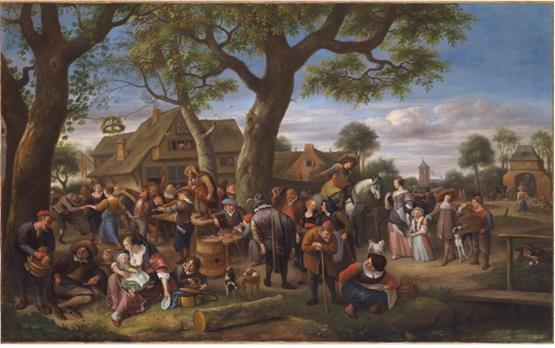
Jan Steen (1626-1679), Peasants Merrymaking Outside an Inn (previously Fair at Warmond), ca. 1676. Oil on canvas. The Leiden Collection, JS-108. Courtesy of The Leiden Collection, New York

New York, NY –This spring, The New York Historical provides visitors with an extraordinary glimpse into life in New Amsterdam through portraits, genre scenes, and still life paintings created by renowned 17th-century Dutch masters, among them, Rembrandt van Rijn. The exhibition, Old Masters, New Amsterdam , is on view May 1 to August 30, 2026.

In this first-of-its-kind exhibition, which celebrates the 400th anniversary of the founding of New Amsterdam, paintings by Rembrandt and his contemporaries help imagine the world of the Dutch settlement that would eventually become New York, depicting people at home, at the marketplace, at prayer, at play, and in taverns.

Featuring objects from The New York Historical’s collection and more than 60 Dutch 17th-century paintings, including works from the Leiden Collection—among the largest and finest collections of 17th-century Dutch art in private hands—the exhibition also includes works from a variety of institutions, including the Museum of Fine Arts Boston, National Gallery of Art, Virginia Museum of Fine Arts, the New York State Archives, and Trinity Church, as well as private collectors.

“As we continue our commemoration of the United States’ 250th anniversary, we are thrilled to have the opportunity to showcase works of art by Rembrandt van Rijn, Frans Hals, and Jan Steen, many of which have never before shown in New York,” said Dr. Louise Mirrer, president and CEO of The New York Historical. “Old Masters, New Amsterdam is a fascinating view into daily life in New Amsterdam—a diverse settlement and a place of commerce, creativity, and conflict, which laid the foundations of the city and nation we know today.”

“Four centuries ago, the Dutch founded an outpost at the tip of Manhattan Island—a humble but vibrant settlement that would give rise to New York,” said Russell Shorto, the exhibition’s co-curator, director of the New Amsterdam Project at The New York Historical. “Across the ocean, meanwhile, Rembrandt and his peers were transforming art, revealing the beauty and drama of everyday life. These Dutch artists never set foot in New Amsterdam, but their portraits, character studies, and depictions of daily life in the Netherlands provide real insight into the world of Manhattan’s 17th-century settlers.”

“The Dutch greatly enjoyed family festivities that included music, dancing, food, and drink,” said Arthur Wheelock, co-curator of the exhibition, and senior advisor to the Leiden Collection. “Jan Steen’s joyous Peasants Merrymaking Outside an Inn, for example, wonderfully captures the vibrancy and wide range of human interactions that could be found at a country fair, whether in the Netherlands or in New Amsterdam.”

In the 1600s, the tiny Dutch Republic became a global power, outpacing larger nations through bold innovations in trade and finance. By entrusting overseas ventures to private companies, the Dutch extended their reach across the oceans, bringing home spices, textiles, and extraordinary wealth.

From 1626 to 1664, New Amsterdam was the capital of New Netherland, a colony established by the Dutch West India Company that stretched across parts of five future states. The Dutch policy of religious toleration spawned an unusually pluralistic society, in which at least 18 languages were spoken. The city’s position and its diverse inhabitants made it a hub of global trade in the Atlantic network.

Some of the finest Dutch artists of the 17th century, among them Rembrandt van Rijn, Jan Lievens, Gabriel Metsu, Frans Hals, and Jan Steen, painted portraits and character studies. Though portraying scenes in the Netherlands, these works of art offer hints of what life was like in New Amsterdam for government officials, fur traders, preachers, doctors, and women at home and in the markets. One of the most memorable portraits on view is Rembrandt’s engaging Self-Portrait from 1634, which the young master painted just as he was becoming Amsterdam’s most celebrated artist. Rembrandt’s large portrayal of a dignified Amsterdam merchant, painted much later in his career, projects the gravity of a wealthy gentleman who has assumed social and political responsibilities in his life.

Homes in New Amsterdam echoed those of the old country, though they were generally more modest. Paintings of Dutch interiors on view offer glimpses into the rhythms of domestic life on Manhattan Island. As evident in Gerrit Dou’s Herring Seller and Boy, shopkeeping was a common way for a woman to make a living at home during the era. Paintings of Dutch women reading also echo the habits in New Amsterdam, where people devoured books and pamphlets. Each arriving ship brought letters with news from the home country. Gabriel Metsu’s Smoker Seated at a Table, and Caspar Netscher’s Two Women in an Interior with a Basket of Lemons, also provide tangible examples of how integral the transatlantic trade had become during this period, and how it brought luxury products within reach of ordinary citizens.

The exhibition includes market scenes as well as still-life paintings by Pieter Claesz and Frans Snyders that depict the types of foods that could be savored in New Amsterdam. Tavern life, where the Dutch enjoyed gathering for drink and song, is also seen in several works. Music was a constant feature in Dutch life, whether in the quietude of one’s home, on street corners, or at county fairs, as in Jan Steen’s large Peasants Merrymaking outside an Inn.

The story of New Amsterdam is also one of exploitation. Indigenous people were displaced, and the first enslaved Africans arrived only a year after the city’s founding. On display from The New York Historical’s collections are maps, portraits, and a deed from 1651 granting property north of New Amsterdam to Manuel de Spangie, a formerly enslaved African who had won his freedom a few years earlier. Works by the Bohemian artist Wenceslaus Hollar showcase rare likenesses of people whose societies were reshaped by colonialism, including Native Americans. The figures shown in Head of a Young Black Boy (1635) and Head of a Black Woman with a Lace Kerchief Hat (1645) may have been household servants in Amsterdam or Antwerp. While slavery was technically illegal in Amsterdam, the line between “servant” and “slave” was a blurry one.

Also on view are two foundational documents in the early struggle for religious freedom in America: the Flushing Remonstrance and the journal of Quaker leader John Bowne.

The exhibition ends with several paintings providing a glimpse into 1776 and beyond. The individuality fostered in the Dutch era evolved into a New York hallmark: a brash, confident, entrepreneurial energy. On the eve of the American Revolution, the city’s diversity made it a cauldron of debate and unrest. Built on Dutch foundations and shaped by waves of newcomers, New York reflected the American experiment and propelled it forward. From The New York Historical’s collection, Francis Guy’s 1797 painting Tontine Coffee House, New York City, where commercial activity seemingly bursts across the canvas, shows the expansive growth of the city in the century after the Dutch founded New Amsterdam.

Accompanying the exhibition is a digital 3D reimagining of the 1660 Castello Plan. Created in partnership with the New Amsterdam History Center, this interactive map lets visitors step directly into 17th-century New Amsterdam—exploring the interior of a home and visiting the original City Hall, the Indian Trading House, and a house where enslaved Africans lived. The map also traces the Lenape trail that would later become Broadway, revealing the living city beneath today’s street.

The exhibition is co-curated by Russell Shorto, director of the New Amsterdam Project at The New York Historical, and Arthur K. Wheelock Jr., senior advisor to the Leiden Collection.

Programming
On May 4, the exhibition’s co-curator Russell Shorto and the Leiden Collection’s Elizabeth Nogrady lead a special tour of Old Masters, New Amsterdam, offering an Old Master’s view of New Amsterdam. On May 20, author Alan Mikhail joins Russell Shorto to explore the exceptional story of one of New York’s most unorthodox founding families, a poor immigrant couple named Anthony and Grietje, who arrived in Dutch New Amsterdam in the 1630s in search of a better life and ended up changing the course of New York’s history.

For families, there will be story time themed to the exhibition. Visit the family calendar for details. Private group tours can also be arranged throughout the exhibition.

New York’s first museum, The New York Historical is a leading cultural institution covering over 400 years of American history. A museum of museums and a collection of collections, The New York Historical is home to the Patricia D. Klingenstein Library, the Center for Women’s History, the DiMenna Children’s History Museum, and the future American LGBTQ+ Museum.

The New York Historical, 170 Central Park West, New York, NY 10024. Connect at nyhistory.org and @nyhistory on FacebookTwitterInstagramTikTokYouTube, and Tumblr.

For more travel features visit:

goingplacesfarandnear.com

Going Places @ longislandpress.com

www.longislandpress.com/category/vacation-travel/ 

goingplacesnearandfar.wordpress.com

moralcompasstravel.info

travelwritersmagazine.com/TravelFeaturesSyndicate/

goingplacesfarandnear.tumblr.com/

instagram.com/going_places_far_and_near/

instagram.com/bigbackpacktraveler/

‘Like’ us on facebook.com/NewsPhotoFeatures

X: @TravelFeatures

Threads: @news_and_photo_features

The Gay Harlem Renaissance: The New York Historical Explores Black LGBTQ+ Life in the Early 20th Century

The New York Historical’s new exhibit, The Gay Harlem Renaissance, examines the Black LGBTQ+ artists, writers, and performers central to the Harlem Renaissance and everyday Black gay life in the early 20th century. It is on view through March 8, 2026 © Karen Rubin/goingplacesfarandnear.com

New York, NY—The New York Historical’s new exhibit, The Gay Harlem Renaissance, examines the Black LGBTQ+ artists, writers, and performers central to the Harlem Renaissance and everyday Black gay life in the early 20th century. Marking the centennial of The New Negro—the landmark 1925 anthology edited by Alain Locke—the exhibition traces the queer creativity, friendship circles, and mentorships that flourished in Harlem’s salons, social clubs, and thriving nightlife and that helped power the Harlem Renaissance.

This may well be the first exhibition to explore the Harlem Renaissance through a LGBTQ+ lens. “The Gay Harlem Renaissance” is on view through March 8, 2026.

As Harlem grew into the nation’s largest Black metropolis after the First World War, Black Southern and Caribbean migrants, activists, and creatives transformed the neighborhood into a nexus of political activism, creative expression, and community life. Many of Harlem’s most celebrated poets, novelists, and artists were gay or bisexual (some discreetly and others openly); and many of the preeminent blues singers performing in nightclubs and basement speakeasies were lesbian, bisexual, or transmasculine.

Gladys Bentley is featured in New York Historical’s “Gay Harlem Renaissance” (unidentified photographer, 1946-1949. Gelatin silver print. Collection of the Smithsonian National Museum of African American History and Culture)

Whether on Harlem’s biggest stages or in its nightclubs or hidden speakeasies, LGBTQ+ performers took center stage. Together they helped shape the cultural innovation that defined the era. Amid this cultural convergence, queer and straight artists formed close-knit circles—living together, mentoring one another, and exchanging ideas that shaped the future of Black art and culture. Their creative tensions—whether over how openly to depict same-sex desire or the so-called “unrespectable” venues of Harlem’s nightlife—helped shape the bold, expansive spirit of the Harlem Renaissance.

The Gay Harlem Renaissance provides a sweeping portrait of Harlem after the First World War, when a remarkable generation of Black artists, thinkers, and performers—many of them members of the LGBTQ+ community—shaped a new cultural vanguard,” said Dr. Louise Mirrer, president and CEO of The New York Historical. “We hope that this show will invite visitors to consider how intimate friendships, chosen families, and radical ideas about identity helped define the Harlem Renaissance and continue to resonate today.”

As Harlem grew into the nation’s largest Black metropolis after the First World War, Black Southern and Caribbean migrants, activists, and creatives transformed the neighborhood into a nexus of political activism, creative expression, and community life © Karen Rubin/goingplacesfarandnear.com

The Gay Harlem Renaissance shows that Black LGBTQ+ life was far more visible, accepted, and integrated into the daily life of 1920s Harlem than most people imagine,” said George Chauncey, the exhibition’s chief historian, a Columbia history professor who is the author of Gay New York, 1890-1940.  “The exhibition takes visitors to the basement speakeasies, rent parties, and drag balls where ordinary queer and straight people built lives together, as well as to the salons of the cultural elite.”

Featuring more than 200 objects, The Gay Harlem Renaissance unites painting, sculpture, artifacts, documents, photographs, books, and music from collections across the country and celebrates the creativity, innovation, and resilience of Black LGBTQ+ Harlemites.

Highlights of the exhibition include:

  • Employment of the Negro in Agriculture, a 1934 painting by Earle Richardson, on loan from Howard University, honors the resilience of African American agricultural laborers within the oppression of the Jim Crow system.
  • Color, the 1925 first edition of Countee Cullen’s first book of poetry, published when he was 22. Countee Cullen found a champion and mentor in Alain Locke, who included his poetry in The New Negro and helped Cullen accept his sexuality.
  • Gelatin silver print of Gladys Bentley, circa 1927-45. Taunted as a child for her unfeminine demeanor, the transmasculine performer Gladys Bentley became a star in Harlem, singing and playing piano all night at rent parties and popular nightclubs. Her signature white tuxedo and top hat have become icons of queer self-expression on and off the stage.
  • Rent party tickets. Throwing apartment parties with a small cover charge in exchange for entertainment and lively company helped working-class residents pay the rent. The fact that LGBTQ+ Harlemites could dance and flirt with people of the same sex at such parties was a powerful sign of their acceptance among Harlem’s working-class residents.
  • Meditation and Music, a 1925 watercolor by Aaron Douglas. Influenced by the work of Alain Locke, Douglas moved to Harlem, where he illustrated some of the most famous books and magazines of the Harlem Renaissance. While Douglas was not gay, he was close to many Black queer artists and moved in their social circles.
  • Sculptures by Richmond Barthé, whose artworks chart his movement through interracial and transatlantic gay social circles. His subjects included the popular singer and nightclub owner Jimmie Daniels and the queer Senegalese dancer François “Féral” Benga, whom he met in Paris.
  • 1939 issue of The Crisis magazine. Black publications experienced tremendous growth in readership, circulation, and influence during the interwar years. The Black press provided coverage of the vibrant political, cultural, and social life in Harlem and beyond.  
  • Photographs by Morgan Smith and Marvin Smith created an extraordinary documentary record of the Harlem community from the 1930s to 1950s. Their work captured Black joy and struggle alike. They came to know most of the pioneering figures of the Harlem Renaissance as well as rising talent.
  • Recordings of blues songs with queer themes by singers such as Bessie Smith, Ma Rainey, and Ethel Waters, as well as specially created audio recordings of poetry by Langston Hughes and other poets, as well as a passage from Nella Larsen’s novel, Passing.
  • Recreation of the prize-winning gown worn by Bonnie Clark at the 1932 Hamilton Lodge Ball, the largest drag ball on the East Coast, which was held every February in Harlem’s Rockland Palace. 
  • Harlem Diner, a 1938 painting by Jacob Lawrence, depicting five Black figures with downturned expressions gathered in a Harlem diner, facing the struggles of daily life. During the Great Depression, Harlemites faced mass unemployment, overcrowding, and persistent racial discrimination.
Ethel Waters is featured in The New York Historical’s new exhibit, The Gay Harlem Renaissance © Karen Rubin/goingplacesfarandnear.com

The exhibition is curated by lead curator Allison Robinson, associate curator of history exhibitions; with Anne Lessy, assistant curator of history exhibitions and academic engagement; with Rebecca Klassen, curator of material culture and decorative arts, contributing; and with George Chauncey, author of Gay New York and DeWitt Clinton Professor of American History at Columbia University, as chief historian.

Programming: A family guide for young visitors to the exhibition will be available. Living History programs focused on Gladys Bentley will also take place at a future date. Visit the family calendar for details. Private group tours can also be arranged throughout the exhibition.

Lead support for The Gay Harlem Renaissance is provided by the Mellon Foundation. Important support is provided by Pamela and David Hornik. Exhibitions at The New York Historical are made possible by Dr. Agnes Hsu-Tang and Oscar Tang, the Saunders Trust for American History, the Evelyn & Seymour Neuman Fund, the New York City Department of Cultural Affairs in partnership with the City Council, and the New York State Council on the Arts with the support of the Office of the Governor and the New York State Legislature. WNET is the media sponsor.

New York’s first museum, The New York Historical is a leading cultural institution covering over 400 years of American history. Offerings span groundbreaking exhibitions; peerless collections of art, documents, and artifacts; acclaimed educational programs for teachers and students nationwide; and thought-provoking conversations among leading scholars, journalists, and thinkers about the past, present, and future of the American experiment. The New York Historical is a museum of museums and a collection of collections and home to the Patricia D. Klingenstein Library, the Center for Women’s History, the DiMenna Children’s History Museum, and the future American LGBTQ+ Museum. “We elevate the perspectives and scholarship that define the United States’ democratic heritage and challenge us all to shape our ongoing history for the better.”

The New York Historical, 170 Central Park West (77th Street), New York, NY 10024, 212-873-3400, nyhistory.org.

For more travel features, visit:

goingplacesfarandnear.com

Going Places @ longislandpress.com

www.longislandpress.com                                   

goingplacesnearandfar.wordpress.com

moralcompasstravel.info

travelwritersmagazine.com/TravelFeaturesSyndicate/

goingplacesfarandnear.tumblr.com/

instagram.com/going_places_far_and_near/

instagram.com/bigbackpacktraveler/

‘Like’ us on facebook.com/NewsPhotoFeatures

X: @TravelFeatures

Threads: @news_and_photo_features

Bluesky: @newsphotosfeatures.bsky.social

The New York Historical Launches Campaign to Honor the 250th Anniversary of the United States’ Founding in 2026

Along with a suite of exhibitions, The Historical partners with history museums from across the nation to invite Americans to share their birthdays wishes “On Our 250th”

As the nation prepares for the 250th anniversary of its founding, The New York Historical has announced a broad suite of exhibitions and programs, and a digital campaign joined by a nation-wide coalition of history museums, named “On Our 250th.” The initiative has just begun with the launch of onour250th.org, where individuals can share a birthday wish for their nation and its democracy turning 250. © Karen Rubin/goingplacesfarandnear.com

New York—As the nation prepares for the 250th anniversary of its founding, The New York Historical has announced a broad suite of exhibitions and programs, and a digital campaign joined by a nation-wide coalition of history museums, named “On Our 250th.” The initiative has just begun with the launch of onour250th.org, where individuals can share a birthday wish for their nation and its democracy turning 250. The exhibitions will begin in fall 2025, with a major exhibition of Revolutionary-era documents from the David M. Rubenstein Americana Collection, and then include shows on immigration photography, contemporary artists’ reflections on the anniversary, and exhibitions on Revolutionary Women and on how New York celebrated the nation’s bicentennial. Plus, in early summer 2026, The Historical will have the grand opening of its new Tang Wing for American Democracy.

“On Our 250th” 
“On Our 250th” is a partnership organized by The New York Historical and Made by US of history museums across the nation to invite individuals to share a public message of their hopes for our nation and its democracy on the occasion of its anniversary. On both a microsite—onour250th.org—and on-site at museums across the nation, this campaign will collect five to 50 word greetings from Americans of all ages. The campaign already has 23 participating history museums across 15 states, including Wyoming, Georgia, Virginia, and Illinois, plus the Smithonian’s National Museum of American History. The website was created by Use All Five, a digital design agency.

“We have planned these exhibitions and programs in the hope of bringing our fellow citizens new insights into who we are and have been as Americans,” said Dr. Louise Mirrer, president and CEO, The New York Historical. “As an institution established by veterans of the American Revolutionary War, with the objective of ensuring that future generations would know of, and value the nation’s great struggle for freedom and equality, we are firm in our belief that, by understanding the past and appreciating the people on whose shoulders we stand, our democracy will thrive.”

The New York Historical launched the microsite today with 250 greetings from students, including this potent note from Andrea, a middle school student in New Jersey: “Happy Birthday, USA! My wish for you is to once again be a united country meant to protect and serve all. To return to a land of opportunity and diversity for all who seek it.” Participating institutions include: Atlanta History Center, Chicago History Museum, Democracy Center at the Japanese American National Museum, Harriet Beecher Stowe House, The Heurich House Museum, Idaho State Museum, Jamestown-Yorktown Foundation, Levine Museum of the New South, Lincoln Presidential Foundation, National Liberty Museum, National World War I Museum and Memorial, The New York Historical, Revolutionary Spaces, Robert H. Jackson Center, Ruth Mott Foundation/Applewood, Senator John Heinz History Center, Smithsonian’s National Museum of American History, Theodore Roosevelt Presidential Library, Thomas Jefferson’s Monticello, Vermont Historical Society, Virginia Museum of History & Culture, Woodrow Wilson Presidential Library and Wyoming State Museum.

Exhibitions
The exhibitions related to the 250th anniversary will take place over a 15-month period, from October 2025 to December 2026, in both The Historical’s main building and, starting summer 2026, its new Tang Wing for American Democracy. The exhibitions include:

Declaring the Revolution: America’s Printed Path to Independence
Fall 2025
Visitors have the unique opportunity to see a selection of landmark documents from the David M. Rubenstein Americana Collection showcasing America’s founding era on display together.

Arriving in America: Portraits of Immigrants from The New York Historical Collections
Fall 2025
This exhibition mines the vast photography collections of the Patricia D. Klingenstein Library as a lens to view the immigrant experience in New York through the faces and places photographers have captured over time.

Revolutionary Women
February 2026
Showcasing the little known and unknown achievements of women in the years leading up to, during, and following the Revolutionary War, this exhibition brings new insights into the nation’s founding.

Old Masters and New Amsterdam
Spring 2026
Who were the people of the Dutch Golden Age who founded the colony that would become New York? What drove them to set sail and colonize? A dazzling array of more than 60 Dutch Old Master paintings, featuring works by Rembrandt van Rijn, Frans Hals, Jan Lievens, and Jan Steen, provides viewers with clues into the Dutch society that spawned New York.

Democracy Matters
Summer 2026
Why does democracy matter? What does it look like in action? Whom does it represent? Objects from The New York Historical’s Museum and Library collections join works by contemporary New York City-based artists. Together, they explore the original promise of and continuing progress toward the American Revolutionary ideals of liberty and equality.

“You Should be Dancing”: New York, 1976
Fall 2026
In 1976, New York City was in crisis. Its youth rescued and reinvigorated it. You Should Be Dancing transports the visitor to a year of contradictions for New York City. The metropolis was the main stage for America’s 200th birthday celebration, with days of parades, festivals, and performances. But it also faced near-bankruptcy, spiking crime, and a housing and drug crisis. Out of this moment emerged musical genres driven by the city’s youth—including disco, punk and hip hop—which forever changed music history.This exhibition surrounds the visitor with music, fashion, instruments, photographs, and original documents to learn about the glitz and grit of this transformative year in New York City’s history.

The Tang Wing for American Democracy

The Tang Wing for American Democracy, dedicated to exhibitions and programming on democracy, opens in time for the nation’s 250th anniversary. The Tang Wing for American Democracy will house the Academy for American Democracy, the Dorothy Tapper Goldman Center for Teaching Democracy, new gallery spaces and classrooms, a conservation studio, and the first home of the American LGBTQ+ Museum (opening at a later date). The new wing will also be the home of The New York Historical’s MA in Museum Studies program, a trailblazing initiative founded in 2019 with the CUNY School of Professional Studies, and a renovated library stack storage tower for the Patricia D. Klingenstein Library, which holds more than 10 million items, including rare copies of our nation’s foundational documents.

New York’s first museum, The New York Historical  (formerly known as the New-York Historical Society) is a leading cultural institution covering over 400 years of American history. The New York Historical is a museum of museums and a collection of collections. It is home to the Patricia D. Klingenstein Library, the Center for Women’s History, the DiMenna Children’s History Museum, and the future American LGBTQ+ Museum.

The New York Historical, 170 Central Park West (77th Street), New York, NY 10024, 212-873-3400, nyhistory.org.

For more travel features, visit:

goingplacesfarandnear.com

Going Places @ longislandpress.com

www.longislandpress.com                                   

goingplacesnearandfar.wordpress.com

moralcompasstravel.info

travelwritersmagazine.com/TravelFeaturesSyndicate/

goingplacesfarandnear.tumblr.com/

instagram.com/going_places_far_and_near/

instagram.com/bigbackpacktraveler/

‘Like’ us on facebook.com/NewsPhotoFeatures

X: @TravelFeatures

Threads: @news_and_photo_features

Bluesky: @newsphotosfeatures.bsky.social

The New York Historical Presents Timely Exhibit: Blacklisted: An American Story, Examining the Red Scare, Hollywood Blacklist and Impact on American Culture

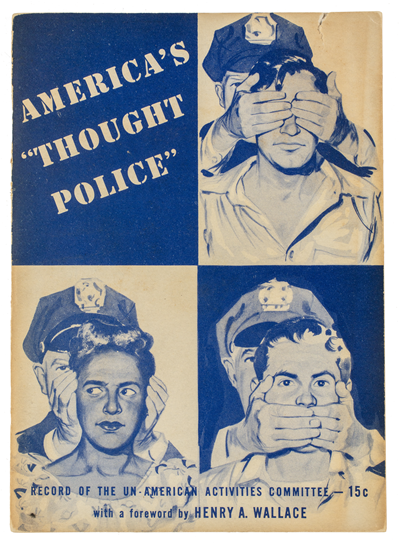
Opening June 13, The New York Historical highlights the intersection of politics, art, and culture that shaped America’s Red Scare in Blacklisted: An American Story, on view June 13-October 19, 2025  (credit: Civil Rights Congress, America’s “Thought Police”: Record of the Un-American Activities Committee, 1947. Courtesy of the Unger Family)

New YorkOpening June 13, The New York Historical highlights the intersection of politics, art, and culture that shaped America’s Red Scare in Blacklisted: An American Story, a traveling exhibit created by the Jewish Museum Milwaukee. Expanded by The Historical, the exhibition builds on the story of the Red Scare and the blacklisting of screenwriters and directors known as the Hollywood Ten, and the countless others who were impacted. Blacklisted captures the tensions of the domestic Cold War, revealing how global politics infiltrated America’s entertainment industry in the late 1940s and 50s through a government crackdown on artistic expression. The exhibit is on view through October 19, 2025.

“Our aim with Blacklisted is to prompt visitors to think deeply about democracy and their role in it,” said Dr. Louise Mirrer, president and CEO of The New York Historical (formerly known as the New-York Historical Society). “The exhibition tackles fundamental issues like freedom of speech, religion, and association, inviting reflection on how our past informs today’s cultural and political climate.”

The Hollywood Blacklist emerged as a key manifestation of the Red Scare in the postwar United States. With the rise of global Communism during the Cold War, anxiety over the emergent power and influence of the Soviet Union fanned fears domestically. Numerous industries purged employees suspected of being sympathetic to Communism. Hundreds of people lost their jobs, and thousands stood by silently, afraid of jeopardizing future employment.

The exhibition opens with a look at the first Red Scare, which came on the heels of the First World War. Wartime heralded a crackdown on both immigrants and political dissidents, particularly critics of war. Hundreds of immigrant activists were deported, including Emma Goldman. A pamphlet she co-wrote in 1919, Deportation: Its Meanings and Menace; Last Message to the American People, is on display.

Social conditions of the 1930s and 1940s drove many artists and writers to embrace radical politics through groups like the Communist Party USA (CPUSA). During this period, the CPUSA was the only interracial political party and the only party with a platform supporting racial equality and self-determination for Black communities. A 1932 lithograph on view—“Equal Rights for Negroes Everywhere! Vote Communist”—depicts the interracial presidential ticket of William Z. Foster and James W. Ford, the first African American to run for vice president in the 20th century. While this interwar period is considered the “heyday of American Communism,” CPUSA’s official membership never exceeded 100,000. The Red Scare would decimate the CPUSA and shatter many progressive coalitions accused of having Communist ties.

In 1947, the House Un-American Activities Committee (HUAC) called Hollywood figures to testify about allegations of communist propaganda in American films. Although the committee never found any evidence, it held ten of the writers and directors in contempt of Congress and fined and sentenced them to prison. Hollywood responded by creating a self-imposed Blacklist of those implicated in the proceedings. Red-baiting, a move to discredit someone by labeling them as a Communist or Communist sympathizer, became widespread across government, industry, and the media throughout the 1950s.

Objects on view include Blacklisted screenwriter Dalton Trumbo’s Academy Awards for Roman Holiday— originally awarded only to co-writer Ian McLellan Hunter since Trumbo was prohibited from working in film under his own name—and The Brave One, awarded to the fictitious Robert Rich. (Hunter was later Blacklisted.) Also on display are typewriter ribbon tins with personal items Trumbo collected and kept while he was incarcerated and letters written to him by his young daughter during that time.

The ways in which Broadway and New York’s theatre community responded during this era is also explored with a selection of programs, photographs, and other ephemera. On view is an original souvenir book for the 1943 production of Othello, starring Paul Robeson, an active Communist and the first Black actor cast in the role in a major US Shakespearean production, who was later investigated for his political expressions. Originally staged in 1934, The Children’s Hour was revived in 1952 at the height of the Red Scare and directed by its playwright Lillian Hellman, who had been blacklisted in Hollywood. A vintage photograph of Hellman, taken by Editta Sherman, is among the many theatre-related objects on view.

Blacklisted features more than 150 artifacts, including historical newspaper articles, film clips, testimony footage, telegrams, playbills, court documents, film costumes, movie posters, scripts, artwork, and Academy Award statuettes. Additional highlights include:

  • “100 Things You Should Know About Communism in the USA” pamphlet from the Committee on Un-American Activities (1949), which was handed out at the House Committee on Un-American Activities (HUAC) hearings;  
    • Lauren Bacall’s costume from How to Marry a Millionaire, a 1953 film released during the height of the Blacklist. Bacall was one of the founding members of the Committee for the First Amendment, which initially supported the Hollywood Ten. Unlike other committee members, her employment opportunities did not diminish, and she worked steadily until her death; 
    • From Life magazine in 1953 “Satan Came to Salem: Arthur Miller Play Exposes Horror and Hysteria of Witch Hunt”, an article discussing the relevance of The Crucible and interpreting the play’s setting during the Salem Witch Trials and its focus on the devastating role of rumor and accusation as a searing commentary on HUAC and the widespread panic during the Red Scare; 
    • A 1949 Carnegie Hall program “Hazel Scott: In her Piano Program of Bach to Boogie-Woogie,” from jazz pianist and singer Hazel Scott, who made a name for herself at Café Society, the first integrated nightclub in New York City. The first Black woman to have her own television show, her name was listed in Red Channels, a Red-baiting publication, which led to the cancellation of her show one week later after a single episode had aired; and 
    • A record cover of The World of Sholom Aleichem, (1953), a significant creative and cultural achievement during the Red Scare, which drew on the works of Yiddish humorist Sholom Aleichem, with a cast and crew almost entirely composed of Blacklisted artists, including Jack Gilford, Sarah Cunningham, Ossie Davis, director Howard da Silva, and writer Arnold Perl. 

Blacklisted: An American Story is a traveling exhibit created by the Jewish Museum Milwaukee and coordinated for The New York Historical by Anne Lessy, assistant curator of history exhibitions and academic engagement, with contributions from Emily Pazar, assistant curator of decorative arts and material culture.

Programming 
On Wednesday, June 18, celebrated biographer Kai Bird joins David M. Rubenstein in discussion on Roy Cohn’s upbringing in mid-century New York, the rise of his political and legal career which was informed by Red Scare tactics, and his ties to the era of McCarthyism. In October, families can take part in our Reading into History program themed to the exhibition, offering a selection of reading suggestions and historical activities. Visit the DiMenna Children’s History Museum calendar for more details. Private group tours can be arranged throughout the exhibition.

Support 
Lead support for Blacklisted: An American Story is provided by the Ford Foundation and Sy and Laurie Sternberg. Major support is provided by the David Berg Foundation and the Blanche and Irving Laurie Foundation. Additional support is provided by Kate Kelly and George Schweitzer, Patricia Askwith Kenner, and Ambassador John L. Loeb, Jr.

Exhibitions at The New York Historical are made possible by Dr. Agnes Hsu-Tang and Oscar Tang, the Saunders Trust for American History, the Evelyn & Seymour Neuman Fund, the New York City Department of Cultural Affairs in partnership with the City Council, and the New York State Council on the Arts with the support of the Office of the Governor and the New York State Legislature. WNET is the media sponsor. 

New York’s first museum, The New York Historical is a leading cultural institution covering over 400 years of American history. The New York Historical is a museum of museums and a collection of collections. It is home to the Patricia D. Klingenstein Library, the Center for Women’s History, the DiMenna Children’s History Museum, and the future American LGBTQ+ Museum. Connect with us at nyhistory.org or at @nyhistory on FacebookTwitterInstagramTikTokYouTube, and Tumblr.

The New York Historical, 170 Central Park West (77th Street), New York, NY 10024, 212-873-3400, nyhistory.org.

For more travel features, visit:

goingplacesfarandnear.com

Going Places @ longislandpress.com

www.longislandpress.com                                   

goingplacesnearandfar.wordpress.com

moralcompasstravel.info

travelwritersmagazine.com/TravelFeaturesSyndicate/

goingplacesfarandnear.tumblr.com/

instagram.com/going_places_far_and_near/

instagram.com/bigbackpacktraveler/

‘Like’ us on facebook.com/NewsPhotoFeatures

X: @TravelFeatures

Threads: @news_and_photo_features

Bluesky: @newsphotosfeatures.bsky.social