Category Archives: National Parks

With Stroke of Obama’s Pen, Pacific Remote Islands Marine National Monument Becomes Largest Marine Reserve in World

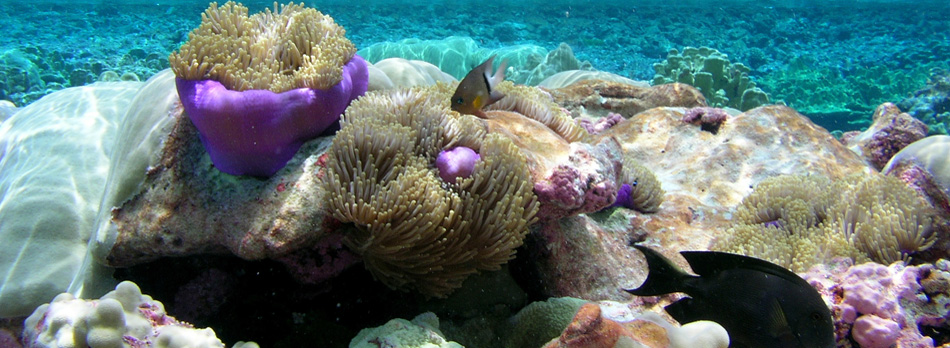
Heteractis Magnifica Isla Maxima tidepools at Pacific Remote Islands Marine National Monument. Obama signed a proclamation expanding the protected area to six times its size, becoming the largest marine reserve in the world (photo from FWS).

With the stroke of a pen, President Obama expanded the existing Pacific Remote Islands Marine National Monument, one of the most pristine tropical marine environments in the world, to six times its current size, resulting in 370,000 square nautical miles (490,000 square miles) of protected area around these tropical islands and atolls in the south-central Pacific Ocean, making it the largest marine reserve in the world that is completely off limits to commercial resource extraction including commercial fishing.

Expanding the Monument, which was first designated by George W. Bush on January 6, 2009, will more fully protect the deep coral reefs, seamounts, and marine ecosystems unique to this part of the world, which are also among the most vulnerable areas to the impacts of climate change and ocean acidification.

Commercial fishing and other resource extraction activities, such as deep sea mining, are banned in the Monument.  But in recognition of the importance of encouraging and supporting access to federally managed areas, recreational and traditional fishing consistent with the conservation goals of the Monument will continue to be allowed in the expanded Monument.

“An ocean paradise teeming with rare marine life and birds surrounding atolls and reefs about 1,000 miles southwest of Hawaii, the newly-expanded Pacific Remote Islands Marine National Monument further protects those ecosystems and their creatures—some of which are found nowhere else on earth,” the Wilderness Society wrote.

“Safeguarding these islands and their underwater ecosystems will help ensure the survival and recovery of several threatened and endangered species such as leatherback turtles, blue and humpback whales, whitetip sharks, and yellowfin tuna. The islands attract millions of migratory seabirds and the coral reefs in this area are full of colorful fish and anemones.

“The Pacific Remote Islands Marine National Monument is like the Galapagos Islands in terms of the significance of this habitat for wildlife and its value for scientific research. The expansion of the monument garnered overwhelming support from scientists, businesses and conservation groups.”

The recently released National Climate Assessment confirms that climate change is causing sea levels and ocean temperatures to rise. Changing temperatures can harm coral reefs and force certain species to migrate. In addition, carbon pollution is being absorbed by the oceans, causing them to acidify, which can damage coastal shellfish beds and reefs, altering entire marine ecosystems. To date, the acidity of our ocean is changing 50 times faster than any known change in millions of years.

In response to this growing threat, the President announced in June his commitment to use his authority to protect some of our most precious marine landscape just like he has for our mountains, rivers, and forests. The Administration identified expanding the Pacific Remote Islands Marine National Monument as an area of particular interest because science has shown that large marine protected areas can help rebuild biodiversity, support fish populations, and improve overall ecosystem resilience.

To meet the President’s commitment, the Administration examined how to expand protections near the Monument and considered the input of fishermen, scientists, conservation experts, elected officials, and other stakeholders, including through a town hall meeting and over 170,000 comments submitted electronically.

The expanded Monument will include over 130 newly protected sea mounts, which are hotspots of biodiversity that harbor uncounted numbers of new and unique marine species. The expansion will better protect the habitat of animals with large migration and foraging ranges that stretch throughout the area, including sea turtles, marine mammals, and manta rays.  The Monument is also home to millions of seabirds that forage over hundreds of miles and bring food back to their rookeries on the islands and atolls.  These birds serve as a conveyor belt of energy bringing nutrients caught at sea back into the near shore environment where they help sustain the ecosystems.

This proclamation builds on the Administration’s efforts to protect both our lands and our oceans.  Early in his first term, President Obama launched the National Ocean Policy to harmonize the implementation of more than 100 laws that govern our oceans and create a coordinated, science-based approach to managing the many resources and uses of our coasts and oceans.

In June, President Obama launched a series of executive actions to increase protections for the ocean, including combating black market fishing, establishing a pathway to new marine sanctuaries, and understanding the impacts of ocean acidification. The President has also designated 11 other national monuments across the United States to permanently protect sites that are significant to our nation’s rich history and natural heritage.

The expanded monument will continue to be managed by the Departments of the Interior and Commerce through the U.S. Fish and Wildlife Service and National Oceanic and Atmospheric Administration respectively.  The Agencies will develop management plans pursuant to their respective authorities under the Antiquities Act, the Magnuson-Stevens Fishery and Conservation Management Act, and other relevant authorities to ensure proper care and management of the Monument.

First exercised by President Theodore Roosevelt in 1906 to designate Devils Tower National Monument in Wyoming, the authority of the Antiquities Act has been used by 16 presidents since 1906 to protect unique natural and historic features in America, such as the Grand Canyon, the Statue of Liberty, and Colorado’s Canyons of the Ancients.

For more travel features, visit:

www.examiner.com/eclectic-travel-in-national/karen-rubin

www.examiner.com/international-travel-in-national/karen-rubin

travelwritersmagazine.com/TravelFeaturesSyndicate

goingplacesnearandfar.wordpress.com

‘Like’ us on facebook.com/NewsPhotoFeatures

Twitter: @TravelFeatures

New: Moral Compass: Great Places to Go Where the Going Does Good

moralcompasstravel.info

Check out our newest travel site for special deals, insiders’ tips at tidbitts.com: www.tidbitts.com/karen-rubin/where-in-the-world
Fire Island National Seashore’s Wilderness Boardwalk Trail Restored; Events Mark 50th Anniversary of Wilderness Act

On Tuesday, September 2, the National Park Service and Congressman Timothy Bishop celebrated the recent restoration of Fire Island National Seashore’s wilderness boardwalk trail. The ¼-mile boardwalk replaces one destroyed during Hurricane Sandy and provides access to New York State’s only federally designated wilderness.

“The restoration of the wilderness boardwalk on Fire Island is an important step forward in our efforts as a community to fully recover from Superstorm Sandy,” said Congressman Tim Bishop. “In its 50 year history, the Fire Island National Seashore has provided a place for families to spend quality time together while exploring one of Long Island’s most beautiful areas. The restoration of this boardwalk will help to ensure that legacy continues.”

“The federal funds secured by Congressman Bishop made it possible to restore one of Fire Island’s most popular boardwalk in time for the celebration of the 50th anniversary of the Wilderness Act and for Fire Island National Seashore’s own 50th anniversary,” said Seashore Superintendent Chris Soller.

The $273,000 project was completed in April with federal storm recovery funds and visitation has increased since it was completed.

“People come to Fire Island’s wilderness for a unique and peaceful experience and this boardwalk enhances that experience,” said Soller.

“The new wilderness boardwalk was designed to be more sustainable,” said Seashore Facility Manager James Dunphy. Although Hurricane Sandy destroyed 2,500 feet of boardwalk in the wilderness area, Dunphy said “the storm gave the National Park Service the opportunity to reconsider its location.” The new boardwalk was built with composite lumber made from recycled materials and relocated inland to the site of a former boardwalk to allow for greater protection from future storms.

The Otis Pike Fire Island High Dune Wilderness is accessible year-round, with parking available at the adjacent Smith Point County Park.

The Seashore will host “Wilderness Weekend” on September 6 and 7 with special programs to highlight Fire Island’s wilderness and the 50th anniversary of the Wilderness Act.

Wilderness Weekend events include: “Walk in Wilderness,” “Junior Ranger Wilderness Explorer,” and a “Leave No Trace Workshop.”

“Songs of Wilderness,” an exhibit featuring artwork inspired by Fire Island’s wilderness by mixed-media artist David Adams will be on display at the Wilderness Visitor Center through October 13.

The Seashore will continue to host special programming at the Fire Island Wilderness throughout its year-long 50th anniversary celebration starting mid-September.

Fire Island National Seashore encompasses 26 miles of ocean and bay shoreline, lush backdunes, maritime forests and residential communities on Fire Island, a barrier island situated south of Long Island, New York. Fire Island’s dynamic coastal landscape is home to a diversity of plants and wildlife and offers a retreat from nearby metropolitan New York. For more information visit www.nps.gov/fiis.


For more travel features, visit:

www.examiner.com/eclectic-travel-in-national/karen-rubin

www.examiner.com/international-travel-in-national/karen-rubin

travelwritersmagazine.com/TravelFeaturesSyndicate

goingplacesnearandfar.wordpress.com

moralcompasstravel.info

‘Like’ us on facebook.com/NewsPhotoFeatures

Twitter: @TravelFeatures